

Nofollow links and seo: rankings, authority, link attributes, and practical link strategy
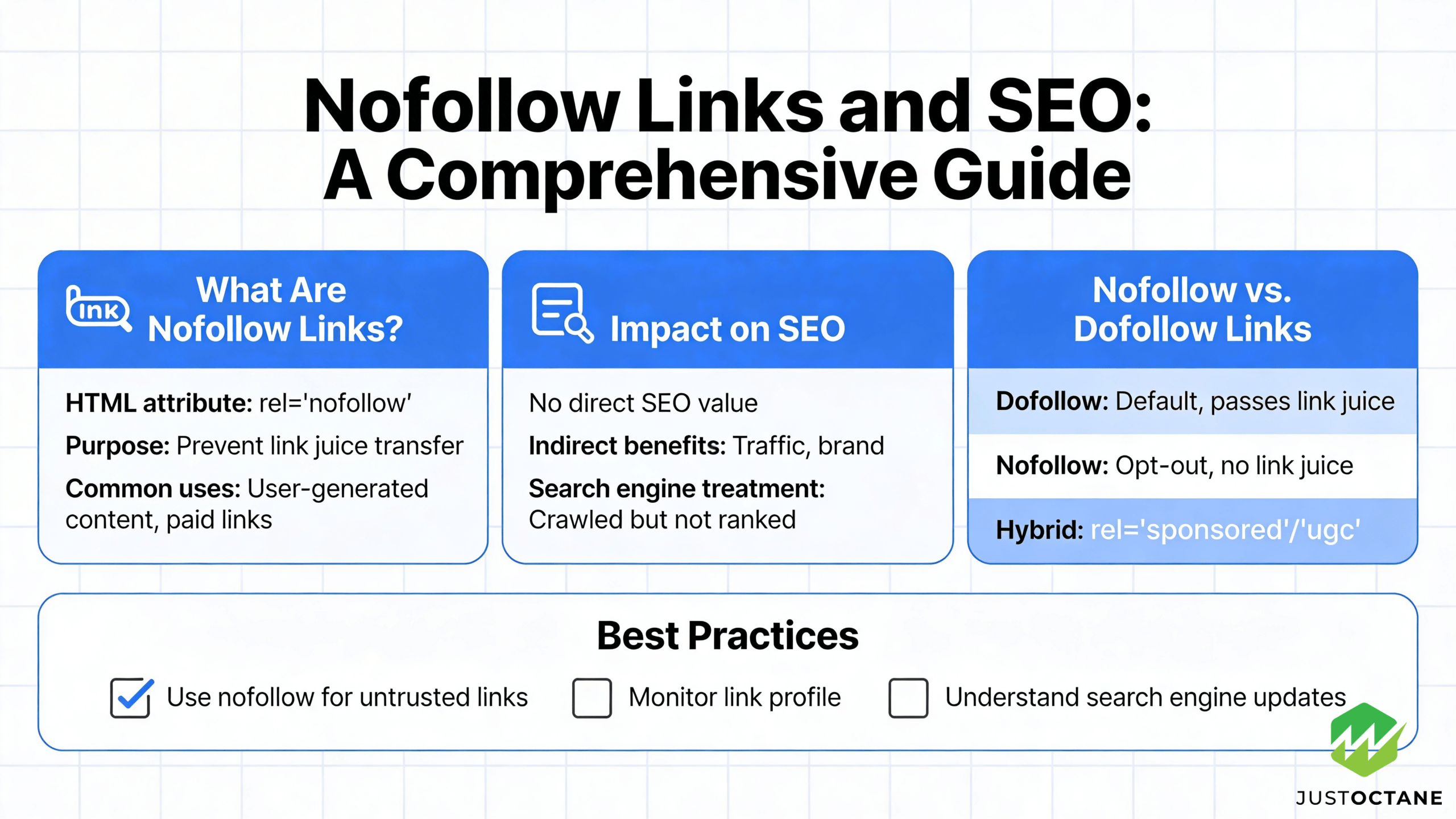
If you’re trying to grow a website through SEO, you’ll run into the same question again and again: do nofollow links matter? The short version is that Google and other search engines use links to understand the web, but not every link is meant to influence search results the same way.
At JustOctane, we look at links the same way a business does: which links generate qualified demand, which links build website authority, and which links increase risk. Those are the links Google ultimately rewards in competitive markets.
Contents
- 1 Do nofollow links help SEO?
- 2 Nofollow vs dofollow links (and the rel attribute)
- 3 How link signals work: pass authority, PageRank, and “hints”
- 4 Why nofollow links are still valuable (even when they don’t pass authority)
- 5 When to use nofollow (comments, UGC, sponsored, and external links)
- 6 Crawling, indexing, and rankings: what nofollow changes (and what it doesn’t)
- 7 How to audit and improve your link profile (a JustOctane workflow)
- 8 Turning nofollow links into compounding growth
- 9 5 Research-backed SEO Questions & Answers
- 9.1 1. How does crawl budget affect very large websites, and what does the research say?
- 9.2 2. Does adding structured data (schema) directly improve rankings, or does it mainly affect CTR?
- 9.3 3. How strongly do page speed and Core Web Vitals affect rankings and business metrics?
- 9.4 4. What is E‑E‑A‑T (Experience, Expertise, Authoritativeness, Trustworthiness) and how much does it affect ranking?
- 9.5 5. Do user behavior signals (CTR, dwell time, bounce rate) directly change rankings?
- 10 Need help with nofollow vs dofollow?
Do nofollow links help SEO?
Nofollow links usually don’t boost rankings in a direct, reliable way like a traditional “follow” link can. The core point of the nofollow attribute is to reduce how much ranking weight a link can carry.
That said, nofollow links are still valuable because they can drive traffic, earn attention from the right audience, and lead to future editorial coverage. In other words, nofollow links can be “good seo” even when they aren’t designed to pass ranking signals.
Importantly, Google has also explained that it may treat rel values as hints in many cases rather than strict rules. “Evolving ‘nofollow’ – new ways to identify the nature of links” — Danny Sullivan & Gary Illyes, Google Search Central Blog, September 10, 2019
Nofollow vs dofollow links (and the rel attribute)
In everyday SEO language, dofollow links are normal hyperlinks with no special rel value that blocks signals. Nofollow links are hyperlinks that include rel nofollow (often written as “rel nofollow links” in audits). The rel attribute tells search engines what kind of relationship exists—more specifically, it tells search engines whether a link is editorial, paid, or user-generated.
Because “dofollow” isn’t an actual HTML setting, what matters is what you add to the rel attribute: rel="nofollow", rel="sponsored", and rel="ugc".
You can also combine values, and teams sometimes describe it verbally as rel sponsored rel sponsored rel ugc when mapping rules for ads and community contributions. From Google’s perspective, the goal is clarity about intent (paid, user-generated, or editorial).
To understand why the nofollow/dofollow distinction matters, you need a simple mental model: some links can pass authority and even pass pagerank (ranking credit) through the link graph, and some links are meant to reduce or qualify that effect.
A normal link may help search engines pass signals from a linked page to another page; historically, it’s part of how ranking systems and algorithms work. “The PageRank Citation Ranking: Bringing Order to the Web” — Lawrence Page, Sergey Brin, Rajeev Motwani, Terry Winograd, Stanford InfoLab, 1999
With nofollow, the intent is: “here is a link for users, but I’m not editorially vouching for it.” Today, it’s more accurate to think of nofollow as a signal that may be used as a hint. That “treated hints” shift matters for how you evaluate nofollow dofollow mixes and dofollow nofollow balances across a real backlink profile.
In practice, nofollow dofollow links and dofollow nofollow links both show up in competitive markets, and Google sees patterns beyond a single attribute. The algorithm update changes over time are why a smart seo strategy focuses on outcomes, not myths about whether nofollow links pass value.
Backlinks important to SEO don’t just come in one format. Even if a link doesn’t pass classic “vote” signals, it can still be a high-leverage marketing asset. Here are the most common ways nofollow links help:
- High traffic placements can send qualified visitors and improve website traffic immediately (a real traffic site effect).
- They diversify your backlink profile and support a more natural link pattern, including nofollow backlinks alongside dofollow backlinks.
- They can lead to future “earned” mentions, which may turn into follow links later (the “links bring links” loop).
- They help reduce risk when you must link out but don’t want to fully endorse the destination.
For many brands, the best opportunities are on relevant pages where links good seo signals exist: topical alignment, real readership, and strong editorial standards. That’s how you build quality links, earn mentions across more websites, and increase domain authority over time.
In plain language: if a publisher sends real buyers and you can see it in analytics, those are nofollow links good enough to pursue—even if the link is nofollow.
When to use nofollow (comments, UGC, sponsored, and external links)
The role nofollow plays is simple: let users click, while limiting SEO endorsement. For most links website owners publish, you’ll decide whether the link is editorial, paid, or user-generated.
Common cases for nofollow include blog comments and forums (to prevent comment spam and avoid letting spammers benefit), user profiles and other UGC areas, and paid placements like ads, sponsorships, and affiliate links (use rel sponsored or “sponsored rel”).
For UGC, you’ll often use rel ugc. You may also see the shorthand phrase rel ugc google when teams talk about aligning with Google documentation.
Some websites nofollow links automatically in comment sections by adding a nofollow tag. If you run WordPress or another CMS, check the default settings (many platforms apply blog nofollow rules to reduce spam).
For outbound marketing references, focus on whether it’s an editorial citation or a compensated mention. This is especially important for external links that appear sitewide across links websites; add rel=”noopener noreferrer” and reduce manual action risk.
Practical tip: if you’re unsure about a link, check the page source (or use a crawler) and check link attributes directly. This helps you consistently apply types links rules across a large link website.
Crawling, indexing, and rankings: what nofollow changes (and what it doesn’t)
Nofollow is not the same thing as “noindex,” and it doesn’t block crawling by itself. Search engines can still discover URLs across websites, but nofollow can affect how links pass signals and how links pass authority is interpreted for ranking search.
Think in terms of crawling and index behavior. In some situations, SEOs talk about crawling indexing workflows and the indexing purposes of links, especially when diagnosing how a site is discovered. Log file analysis can confirm links matter for crawling indexing purposes, even without reliable ranking credit.
From a measurement standpoint, what you’ll often see is this: nofollow links may not move rank directly, but they can still correlate with better visibility, stronger brand demand, and improved conversion paths. That’s why “nofollow links used intelligently” is a better goal than chasing only one type link or obsessing over search nofollow myths.
How to audit and improve your link profile (a JustOctane workflow)
Most competitor content stops at definitions. The real advantage comes from running a repeatable audit that connects attributes to outcomes. The following approach is what JustOctane uses for clients who want predictable improvement in google ranking and revenue:
1) Export links from Google Search Console and a third-party backlink index, then segment by dofollow links vs nofollow links, plus rel sponsored and rel ugc.
2) Review referring pages for context: is it a “real” editorial mention, a UGC page, or obvious spam?
3) Track what matters: referral sessions in GA4 (with UTM tags), assisted conversions, and lead quality from each placement. You’re looking for impact on both rankings and pipeline—because rankings website traffic without qualified leads isn’t the goal.
4) Improve internal processes so teams label paid/UGC links correctly and avoid accidental policy violations.
Done right, this is how support seo efforts translate into safer growth, stronger search ranking signals, and better links ranking performance in competitive SERPs.
Turning nofollow links into compounding growth
The strongest link programs use nofollow strategically while still pursuing editorial follow links. That often means digital PR, data-led content, and relationship building with publishers where links good for users come first.
As a rule of thumb: prioritize relevance and audience fit over obsessing about whether “nofollow links pass” anything. If a placement is in front of the right buyers, on a trusted domain, and drives engaged sessions, it can still be a win for your brand and pipeline.
5 Research-backed SEO Questions & Answers
1. How does crawl budget affect very large websites, and what does the research say?
Crawl budget matters mainly for very large sites (millions of URLs) or sites that generate many low-value pages (session IDs, faceted navigation, printer pages). Google’s documentation explains that crawl budget is limited by host load and URL freshness, and that improving site quality signals (fewer low‑value pages, correct use of robots.txt, canonical tags, and sitemaps) reduces unnecessary crawling and improves indexing of important pages. Industry analyses (e.g., DeepCrawl, Screaming Frog) and Google’s own guidance show the practical takeaway: focus on reducing duplicate/low-value pages and serving a clean crawl path rather than trying to “increase” budget directly.
2. Does adding structured data (schema) directly improve rankings, or does it mainly affect CTR?
Google states structured data does not create a ranking boost by itself; its documented purpose is to help Google better understand page content and enable rich result features. Empirical studies and A/B tests across the industry consistently show structured data commonly improves click-through rate (CTR) when it produces rich snippets (stars, FAQ, product info), which in turn can indirectly increase organic traffic and possibly benefit rankings over time. In short: schema is not a guaranteed ranking signal, but it reliably improves visibility and CTR when Google uses it to generate enhanced results.
3. How strongly do page speed and Core Web Vitals affect rankings and business metrics?
Google made Core Web Vitals part of the Page Experience signals; those metrics (Largest Contentful Paint, First Input Delay, Cumulative Layout Shift) are used as lightweight ranking signals among many others. Research and multiple industry case studies show faster pages typically produce better user engagement and conversion rates — improvements in load times often increase conversions and reduce abandonment. Practically, CWV can influence rankings where content relevance is similar, and speed improvements almost always improve user outcomes.
4. What is E‑E‑A‑T (Experience, Expertise, Authoritativeness, Trustworthiness) and how much does it affect ranking?
E‑E‑A‑T is a framework used in Google’s Search Quality Rater Guidelines to evaluate content quality. While the raters’ assessments do not directly change rankings, Google uses the rater guidelines to tune algorithms; consequently, signals related to experience, expertise, authority, and trustworthiness (author credentials, site reputation, citations/references, secure site, transparent ownership/contact information) correlate with higher rankings in many studies. Research and correlation studies (e.g., large-scale ranking factor analyses) show sites demonstrating strong E‑E‑A‑T tend to perform better for YMYL and other sensitive topics.
5. Do user behavior signals (CTR, dwell time, bounce rate) directly change rankings?
The short, research-backed answer: clicks and other user interactions are noisy signals and have limitations, so they cannot be treated as a simple ranking lever. Academic research (e.g., Joachims et al.) shows click data can be useful for learning-to-rank models but is biased (position bias, presentation effects). Google has repeatedly warned that single-site analytics metrics (like GA bounce rate) are not direct ranking signals; however, relative user engagement patterns can be one of many signals that help algorithms assess relevance over time. Practically, improving result snippets (title, meta description, structured data) to increase real user clicks and delivering satisfying content reduces pogo-sticking and supports long-term performance.
Need help with nofollow vs dofollow?
If you want an expert review of your backlink profile—plus a clear plan to improve google ranking potential without adding risk—JustOctane can help. Ask for a link audit that flags “nofollow dofollow links,” paid placements, and UGC patterns, and maps each opportunity to business impact.