

Mortgage broker seo: local keyword strategies, google business profile, schema markup, and lead generation
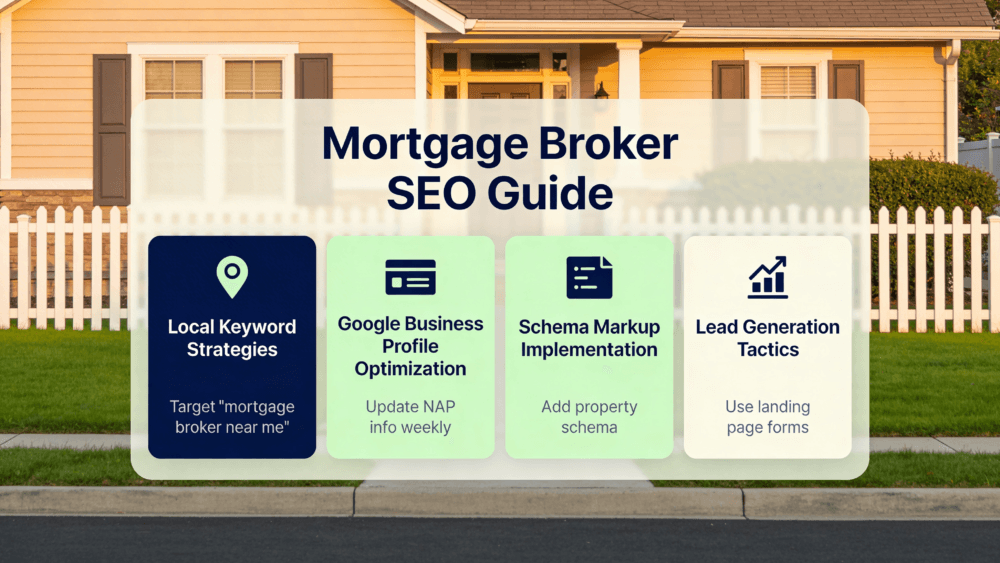
Mortgage broker SEO is the practice of improving a mortgage website so search engines (especially Google) can find your site, understand your services, and send organic traffic that turns into leads and long-term clients. The goal isn’t “more rankings” for vanity terms—it’s more qualified lead generation from the searches your real audience is already doing online, in your local market.
A useful reminder of why authority and links still matter comes from the highly cited paper “The Anatomy of a Large-Scale Hypertextual Web Search Engine” (Brin & Page, 1998), which explains link-based evaluation—the foundation behind modern backlinks and other quality signals.
If you want this executed with a clear marketing plan and measurable results from Google search, JustOctane builds broker SEO strategies for mortgage brokers who need consistent pipeline—not a one-time optimization checklist.
Contents
- 1 1) The fundamentals: what actually moves mortgage SEO
- 2 2) Local SEO: win “near me” visibility with Google Business Profile
- 3 3) Keyword research: focus on intent, not volume
- 4 4) On-page optimization: title tags, meta data, internal links, and schema
- 5 5) Trust and compliance: make your content “finance-safe”
- 6 6) Content that converts: guides, calculators, and conversion tracking
- 7 7) Technical SEO for mortgage sites: Core Web Vitals, mobile indexing, and privacy
- 8 8) Authority building: backlinks, partnerships, and social media
- 9 9) Preparing for new search experiences (AI, answers, and “zero-click”)
- 10 10) Why mortgage SEO fails: common problems that block rankings
- 11 11) A first-month plan you can execute
- 12 How JustOctane helps mortgage brokers grow
- 13 FAQ
- 13.1 1. How does a borrower’s credit score affect mortgage interest rates and approval odds?
- 13.2 2. How do mortgage “points” (origination/buydown points) affect total cost and how do I calculate break-even time?
- 13.3 3. What role do automated underwriting systems (AUS) play, and can they replace human underwriters?
- 13.4 4. How do interest-rate changes affect refinancing volumes and borrower decisions?
- 13.5 5. What behavioral biases commonly affect mortgage decisions and how can brokers mitigate them?
1) The fundamentals: what actually moves mortgage SEO
Every effective SEO strategy for mortgage services comes down to five forces: relevance (matching keywords and intent), coverage (answering the whole topic), depth (the “why” behind the loan options), user experience (fast, clear, mobile-first pages), and trust signals (reviews, brand mentions, and high quality backlinks). When these align, your pages earn stronger search engine rankings across local search and broader organic search results.
Because mortgage content is money-related, your quality bar has to be higher than many industries. Be careful with rates: explain what changes them, add context about APR, points, and fees, and avoid guarantees. This is how you turn “traffic” into potential clients who feel confident enough to call or book.
It also helps to map intent to the right page type. A homepage should sell the brokerage and brand. A service page should explain the service and conversion path. A guide should teach (and still make it easy to contact you). When a site has the right pages for the right searches, the engine has fewer “unknowns,” and users get better results.
2) Local SEO: win “near me” visibility with Google Business Profile
For many mortgage brokers, local SEO is the fastest route to better website traffic and higher-intent leads. Start with Google Business Profile (your Google business profile) and make sure your Google business data is consistent across your website, citations, and directories: business name, address, phone, hours, categories, and service areas.
Next, optimize the profile like a real local business asset. Add services that mirror your keyword research (for example, “FHA loan” or “refinance”), upload relevant photos, and use posts to highlight timely information (rate movement context, local programs, or first-time buyer steps). Use Q&A to pre-answer “how fast can I close,” “what documents do I need,” and “do you work with self-employed borrowers,” because these questions show up repeatedly in local search behavior.
Then build location pages that match how people search (city + loan type), but keep them relevant: one location page per city or neighborhood you truly serve, with unique local information and clear contact paths. Pair these pages with review management—asking for reviews ethically, responding quickly, and using natural language that mirrors real search terms without keyword stuffing.
JustOctane typically also reviews map-pack eligibility issues (service-area settings, duplicate listings, and naming conventions) so your mortgage brokerage doesn’t get filtered out before you ever reach page one.
3) Keyword research: focus on intent, not volume
Keyword research for mortgage broker SEO should start with the moments borrowers feel urgency. You’ll see patterns around mortgage rates, mortgage calculators and payment estimates, pre-approval, refinance, down payment assistance, closing costs, and “best mortgage broker” comparisons. Build around long tail keywords as well as head terms—because long tail often converts better, even if it brings fewer users.
A practical workflow is to combine Search Console queries, call notes, and on-site search logs with a semantic review of the current top search results. This is where distributional approaches (co-occurring phrases and entities) help you identify relevant keywords that “belong together” on the same page, so search engines understand the topic without you forcing repetition.
Once you have a list, assign one primary keyword theme to each page. For example, a city page can target “mortgage broker + city,” while a guide page targets “FHA loan requirements” or “conventional loan vs FHA.” This reduces cannibalization and makes optimization easier over time.
One more nuance competitors often miss: if your market relies heavily on trigger lead purchasing, new privacy and regulation pressure can disrupt that channel quickly. Building an organic lead source protects your brokerage from those swings.
On-page optimization makes it easy for search engines and users to understand each page. Clean up title tags and meta descriptions first, then tighten headers, internal links, and calls-to-action. A strong pattern for service pages is to connect two entities (for example, “Mortgage Rates and Loan Programs in [City]”) so your keyword targets remain clear while still reading naturally.
Think in clusters instead of random blog posts. A practical site structure is: homepage → services → locations → guides → contact. Each guide should link back to the most relevant service page and location page, and those pages should link forward to the guide. This is simple, but it’s one of the most reliable ways to help search engines connect your pages and to keep users moving toward a lead action.
Use schema markup where it genuinely adds clarity: LocalBusiness, FAQPage (only for real FAQs), and Article for guides. For brokers with product-style pages, consider schema types like MortgageLoan or Service when it matches what the page represents. Done well, structured data supports richer search engine results and can improve click-through rate without changing rankings directly.
In short: schema markup helps search engines, and clear internal structure helps users.
5) Trust and compliance: make your content “finance-safe”
Mortgage marketing is held to a higher standard because mistakes can cost consumers real money. Beyond generic SEO tactics, add trust elements directly to the page: clear author attribution (especially if a loan officer wrote or reviewed it), licensing disclosures where required, and an “updated on” date for any page that references rates or program rules.
Be explicit about what your brokerage does and does not do. If you serve multiple states, specify where you’re licensed. If you quote rates, explain that rates depend on borrower qualifications and market conditions. Clear disclosures protect the business, improve user experience, and make your website feel more credible than thin affiliate-style pages.
Also align your conversion flow with that trust. If a page promises “fast pre-approval,” your follow-up process must match. A mismatch can hurt user signals, reduce conversion, and eventually weaken rankings—because the engine is increasingly trying to predict whether users are satisfied with the results they clicked.
6) Content that converts: guides, calculators, and conversion tracking
High-performing mortgage content answers borrower questions in the order they’re asked in real conversations. Create a small library of guides that reduce friction: document checklists, timeline explainers, and “what changes my payment” breakdowns. This is the backbone of digital mortgage marketing because it supports both organic discovery and follow-up nurture.
A simple way to “productize” content is to use repeatable sections (definition, who it’s for, steps, documents, common mistakes, next step). This creates consistent quality across pages, speeds up production, and makes it easier to refresh older content when program rules change.
To improve lead quality, track more than form fills. Connect phone calls, booked appointments, and application-start events back to the pages and keywords that drove them (offline conversion tracking through your CRM and analytics). This is how you separate “traffic” from revenue—especially when a broker ranks well but the leads aren’t right.
JustOctane will often set up reporting so you can see which pages influence conversion, not just the last page before a lead. That matters in mortgage, where buyers may read multiple guides over days or weeks before they contact a broker.
7) Technical SEO for mortgage sites: Core Web Vitals, mobile indexing, and privacy
Technical SEO is where many brokers lose conversions. Google uses mobile indexing, so your mobile pages (forms, menus, and speed) are the baseline for how the engine evaluates your site. Prioritize Core Web Vitals: fast loading, stable layouts, and responsive interactions across mobile devices.
At a minimum, improve performance by compressing images, removing unnecessary scripts, and making sure the website doesn’t block content behind intrusive popups. Also check that your most important pages (home, core services, key locations, and contact) are reachable in a few clicks and don’t throw crawl errors.
Mortgage also raises privacy concerns. Keep forms minimal, secure, and transparent about what data you collect and why. If you run Google Analytics, configure it to avoid collecting sensitive personal information, and ensure your tracking setup doesn’t slow the page or harm user experience.
In competitive markets, authority is the difference between “good pages” and consistent results. Earn high quality backlinks through real estate partnerships (co-authored local guides with agents, builders, and CPAs), community sponsorships, and data-led commentary on market trends. Avoid paid link schemes; they can create short-term spikes and long-term instability.
Support your organic work with social media posts that answer one question at a time. Social media platforms won’t replace SEO, but they can increase brand searches, reinforce trust, and help potential clients choose you when they compare brokers.
9) Preparing for new search experiences (AI, answers, and “zero-click”)
Search is changing, but the winning strategy stays consistent: be the clearest, most useful source. To be eligible for answer-style results, format key pages with concise definitions, short FAQs, and clean schema. This doesn’t mean writing for bots; it means making your information easy to extract and verify—especially for loan officer marketing pages where the promise must match what you can deliver.
Answer-style search is also why you should write “complete” pages. A thin FAQ that only answers one question can lose to a page that explains context, steps, and next actions. When you do this well, it becomes easier to earn links, earn shares, and earn visibility even as search interfaces change.
10) Why mortgage SEO fails: common problems that block rankings
Most ranking drops come from shortcuts: thin location pages, duplicated website content, aggressive popups, and “instant approval” language that hurts trust. Another issue is chasing broad keywords while ignoring long tail intent, which can fill analytics with visitors who never become leads.
A sustainable approach is to keep improving: refresh pages when programs change, update internal links, respond to reviews, and monitor which pages drive real conversion—not only which pages rank. If a page is getting impressions but not clicks, test new title tags and meta copy; if it gets clicks but no leads, review the offer, form friction, and the service messaging.
11) A first-month plan you can execute
In one month, you can build momentum by sequencing work correctly. Week 1: fix technical issues, speed, and mobile experience. Week 2: finalize local SEO (Google business profile, reviews, and the first set of location pages). Week 3: publish two to three high-intent guides based on keyword research. Week 4: earn one or two local backlinks, then optimize what’s already working.
Track progress using a short set of metrics: website traffic from organic, Search Console impressions and clicks, rankings for a small group of intent-heavy keywords, and most importantly the number of leads and lead quality from each page.
How JustOctane helps mortgage brokers grow
JustOctane is an SEO company focused on measurable growth. We combine search engine optimization, conversion optimization, and reporting so you can see which pages, keywords, and campaigns generate leads—not just impressions. Our work typically includes a technical audit, local SEO improvements, keyword research, a content roadmap, and an authority plan built around legitimate partnerships and high quality backlinks.
If you want a clear broker SEO strategy tailored to your market, reach out for a quick audit and roadmap. You’ll leave the call with specific next steps you can execute—whether you partner with JustOctane or implement internally.
FAQ
1. How does a borrower’s credit score affect mortgage interest rates and approval odds?
Multiple industry analyses and lender pricing models show that credit score is one of the primary drivers of mortgage pricing and eligibility (Fannie Mae; Freddie Mac; Consumer Financial Protection Bureau). Borrowers in the top score tiers (commonly 760+ for many lenders) typically qualify for the lowest available rates and highest loan-to-value (LTV) products, while borrowers with scores below common thresholds (for example, <620) face higher interest rates, stricter LTV limits, and more documentation requirements.
Practical implication: across conventional channels, moving from a lower tier to a higher tier can reduce interest rates by several hundred basis points in some cases, materially lowering monthly payments and cumulative interest. Lenders use score bands combined with other risk factors (DTI, LTV, property type) rather than score alone (Fannie Mae risk-based pricing guidance; CFPB analyses).
2. How do mortgage “points” (origination/buydown points) affect total cost and how do I calculate break-even time?
A mortgage point is typically equal to 1% of loan amount and is paid up-front to lower the interest rate. The decision to pay points should be driven by break-even analysis: months to break-even = cost of points / monthly payment reduction. This is a well-established financial rule used in lender pricing and borrower advisement.
Example calculation: on a $300,000 30‑year fixed loan, if the quoted rate is 3.50% (monthly P&I ≈ $1,347) and paying 1 point (cost $3,000) drops the rate to 3.00% (monthly P&I ≈ $1,265), the monthly savings ≈ $82. Break-even = $3,000 / $82 ≈ 36.5 months. If the borrower plans to stay in the home longer than ~3 years, buying the point would be cost-effective in this scenario. This analysis is standard practice in mortgage advising and reflected in lender/broker calculators and academic consumer finance guidance.
3. What role do automated underwriting systems (AUS) play, and can they replace human underwriters?
Automated underwriting systems (e.g., Fannie Mae’s Desktop Underwriter, Freddie Mac’s Loan Product Advisor) are widely used to increase speed, consistency, and throughput in conventional lending. Research and industry reports show AUS can approve many loans based on standardized rules, reducing manual paperwork and turnaround times (industry reports from GSEs and mortgage trade groups).
However, AUS are not a complete replacement for human oversight: lenders still rely on human underwriters for exception cases, fraud detection, complex documentation, and discretionary judgement. Regulatory and academic work on algorithmic decision-making also highlights potential risks—systemic bias, data-quality issues, and the need for human review and audit trails (CFPB and academic analyses on automated credit decisioning). Practically, the efficient model combines AUS for routine eligibility checks with human experts for exceptions and complex risk assessment.
4. How do interest-rate changes affect refinancing volumes and borrower decisions?
Historical data from industry sources (Mortgage Bankers Association and GSE performance reports) show refinancing volumes are highly sensitive to interest-rate movements. When market rates drop meaningfully (commonly cited thresholds are 0.5–1.0 percentage point), refinance applications and originations typically surge as homeowners pursue lower payments, shorter terms, or cash‑out opportunities.
The responsiveness varies by borrower cohort—those with higher existing rates, strong credit, and substantial equity refinance first. Empirical studies of refinancing behavior also point to frictions (transaction costs, inertia, information gaps) that prevent some economically beneficial refinances; these frictions explain why not all eligible borrowers refinance immediately when rates fall.
5. What behavioral biases commonly affect mortgage decisions and how can brokers mitigate them?
Behavioral economics identifies several biases relevant to mortgage choice—status quo bias (preference for current situations), present bias (valuing immediate costs/benefits over future ones), framing effects, and loss aversion. These biases lead some borrowers to avoid beneficial rate buydowns or refinancing, misread long-term costs, or select suboptimal loan features despite objective savings (Kahneman & Tversky; applied consumer finance literature).
Mitigation strategies supported by research and industry best practice include: providing clear, standardized comparisons (monthly payment, total interest, break-even), using illustrative scenarios (short-, medium-, and long‑term cost outcomes), simplifying disclosures, and using decision aids (calculators, visual timelines). Studies and CFPB guidance suggest that clearer, personalized explanations and framing of long-term payoffs improve borrower choices and reduce costly inertia.