

Integrated seo strategies for organic and paid growth
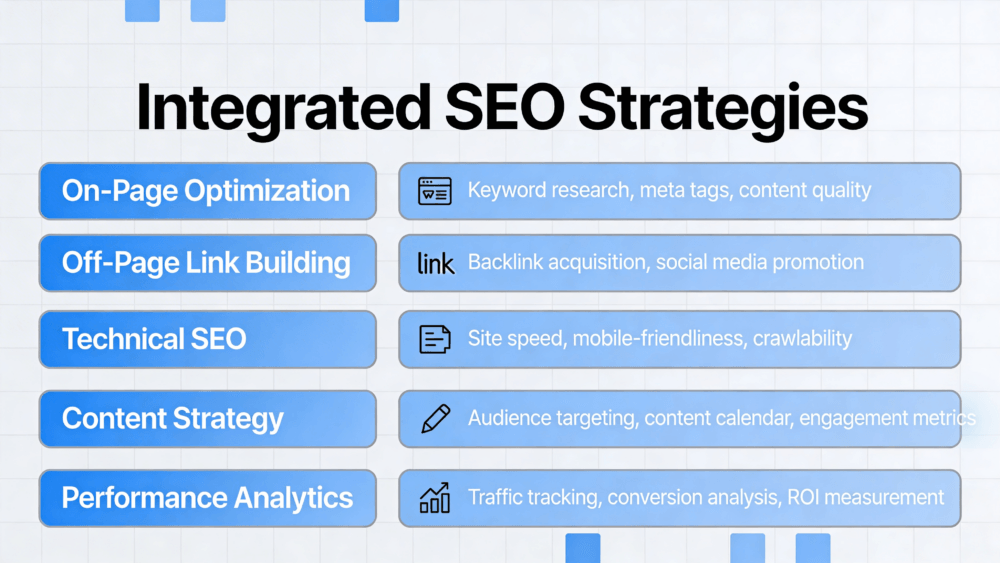
Integrated seo is a practical way to align a single strategy across search, ppc, content, email, and social so your website earns qualified traffic now while building long term organic traffic and brand resilience. Instead of treating organic and paid as separate campaigns, the goal is to coordinate your keywords, your data, and your team so every click and every page improves the next round of marketing efforts—because seo works best when every channel supports the same outcome.
Contents
- 1 What an integrated seo strategy actually is (and what it is not)
- 2 Keyword research + intent mapping for both organic results and paid ads
- 3 3) Web page content, landing-page quality, and quality score (why seo ppc alignment matters)
- 4 The data foundation most competitors skip: tracking, attribution, and first-party signals
- 5 How seo ppc teams share data to drive traffic site-wide
- 6 Measurement that proves impact (beyond last-click reporting)
- 7 Authority building: link building, digital PR, and increasing brand awareness
- 8 Search everywhere: social media, email marketing, and ai overviews llm visibility
- 9 Process and governance: the long term strategy that prevents chaos (and how JustOctane helps)
- 10 FAQ
What an integrated seo strategy actually is (and what it is not)
An integrated seo strategy connects seo paid search execution with the rest of your online marketing so that organic search, paid search, and social media reinforce one another. It is not a “set it and forget it” blog post calendar or a collection of disconnected search strategies from different teams.
In practice, integrated means you build one shared keyword map, one measurement approach, and one cross-channel editorial plan. The result is higher visibility on search engine results, more stable rankings, and a clearer marketing strategy for the business.
Keyword research + intent mapping for both organic results and paid ads
Keyword research is where integrated work begins, because the same keyword can behave differently on a results page SERP depending on intent and competition. Start by unifying keywords from Google Search Console, your paid query reports, and on-site search. Then segment by intent (informational, commercial, navigational) so users land on the right page the first time.
For organic search, prioritize topics that support core service pages and build topical authority. For paid search strategies, prioritize terms where you can control cost and message match quickly. This “one list, two execution paths” approach helps a marketing agency or an in-house team avoid duplicate efforts.
3) Web page content, landing-page quality, and quality score (why seo ppc alignment matters)
High quality content improves more than ranking. It also improves user experience, conversion rates, and—on the paid side—Quality Score by strengthening relevance and landing page experience. If your ads promise one thing and your web page content delivers another, both paid and organic performance suffer.
Use seo ppc collaboration to test headlines, offers, and positioning with small budgets, then apply the winners to titles, meta descriptions, and above-the-fold copy. Over time, this creates a high performing blog and supporting pages that are consistent across channel touchpoints, and it improves performance on the engine results page for both paid and organic placements.
The data foundation most competitors skip: tracking, attribution, and first-party signals
Integrated digital marketing efforts break down when data is fragmented. Beyond basic analytics, build a tracking stack that connects ads, on-site behavior, and lead quality. That usually means clean UTM rules, reliable conversion tracking in Google Ads, and offline conversion imports so you can optimize for qualified leads (not just form fills). For larger accounts, connect GA4 and ad cost data into BigQuery or Looker Studio so attribution and ROI are visible to every team.
If you’re operating in a stricter privacy environment, consider Consent Mode, server-side tagging, and a plan to reduce reliance on third-party identifiers. The goal is simple: keep measurement accurate while respecting users and keeping your site compliant.
As privacy expectations rise, invest in first-party data capture: newsletter signups, gated tools, and CRM enrichment. These signals can support stronger audience targeting (like Customer Match and remarketing lists), better attribution, call tracking clarity, and smarter budget decisions across channels—without over-collecting user data.
The fastest wins happen when seo ppc teams and paid search teams operate on the same data. Your website traffic comes from patterns—queries, devices, locations, and audiences—that show up first in paid search and then compound through organic rankings.
Make these items non-negotiable in the workflow: shared dashboards, shared negative keyword decisions, shared landing page testing, and shared weekly reviews of search engine and search marketing performance. This is the simplest way to help ppc teams reduce waste, help seo teams find new content angles, and drive traffic site growth with fewer duplicated campaigns.
When you do this consistently, integrated seo becomes a repeatable approach digital marketing leaders can defend internally because results connect to revenue.
Measurement that proves impact (beyond last-click reporting)
Most articles mention “reporting,” but few explain how to prove that integrated strategies are causing incremental growth. In addition to standard dashboards, use controlled tests where possible.
- Geo or time-split experiments: hold out a region or time window to measure lift from paid search strategies or content launches.
- Incrementality checks for brand terms: test when ads add value versus when organic search captures demand.
- Pipeline QA: review lead quality regularly so ongoing optimizations don’t chase volume at the expense of sales outcomes.
This tighter measurement improves decision-making across teams, clarifies true cost per acquisition, and keeps marketing efforts focused on what changes business results—not vanity metrics.
Authority building: link building, digital PR, and increasing brand awareness
Link building still matters, but “authority” is bigger than backlinks alone. The best integrated programs pair link building with brand building: expert collaborations, useful tools, and thought leadership that earns mentions and improves brand awareness. Done right, you improve domain authority, earn higher organic results, and reduce your dependence on ads.
A practical rule: promote one strong asset through social email sequences and outreach at the same time you run paid ads social amplification. Coordinated distribution improves engagement signals, builds audience trust, and makes your marketing efforts more efficient.
Search engines are no longer the only discovery surface. Social media, email marketing, and AI overviews are now part of modern search strategies—especially for competitive categories where organic real estate is shrinking.
To improve eligibility for ai overviews (and to protect organic traffic), structure content so it is easy to extract and cite: clear definitions near the top, consistent entity names, concise summaries, and supporting evidence. Add structured data where relevant, and keep your site technically sound so the search engine can crawl and index quickly.
The point is not to chase every platform. It is to run integrated seo digital marketing that keeps one consistent narrative across channels, so users recognize your brand and convert when ready.
Process and governance: the long term strategy that prevents chaos (and how JustOctane helps)
Integrated work fails when teams have different goals. Set shared objectives (pipeline, revenue, qualified traffic), document the strategy, and keep one backlog for campaigns and content. Your long term strategy should include quarterly planning, monthly reporting, and weekly execution reviews so improvements compound into long term success.
If you need support, JustOctane helps businesses design integrated seo plans that connect technical optimization, content production, email marketing, and paid search execution—without the typical handoff gaps between channels. We focus on research-led execution, tight feedback loops between channels, and a reporting layer you can actually use in leadership conversations.
FAQ
Q: How do Core Web Vitals (page experience) affect SEO?
A: Core Web Vitals (Largest Contentful Paint, First Input Delay, Cumulative Layout Shift) are part of Google’s Page Experience signals and can influence ranking as a tiebreaker among otherwise-similar pages. Google research and documentation show these metrics measure real user experience and are used alongside relevance signals; multiple independent analyses find correlations between better Core Web Vitals and improved visibility/engagement, but relevance and content quality remain the dominant ranking factors.
Q: Does using HTTPS improve SEO?
A: Yes—Google confirmed HTTPS is a lightweight ranking signal. Empirical studies from SEO tools find a positive correlation between HTTPS and higher rankings, and HTTPS is required for some browser features and safe data handling, which indirectly supports SEO through better security and user trust. While HTTPS alone won’t outrank better content, it is a low-cost technical baseline you should implement.
Q: Do backlink quality or quantity matter more for SEO?
A: Quality matters more than sheer quantity. Google’s algorithms (including Penguin updates) and multiple industry studies show that links from authoritative, topical, and relevant sites carry substantially more ranking influence than many low-quality links. High-quality backlinks also drive referral traffic and user signals that reinforce relevance; therefore focus on earning authoritative, contextually relevant links rather than mass low-value links.
Q: How important is matching search intent for ranking and CTR?
A: Matching search intent is crucial. Google’s search algorithms aim to satisfy the user’s intent (informational, navigational, transactional, etc.), and studies of ranking factors show that content that aligns with intent achieves higher rankings and click-through rates. Optimizing structure, headings, metadata, and content format to meet the specific intent typically produces measurable gains in organic visibility and engagement.
Q: Can structured data (schema) improve search performance?
A: Structured data (Schema.org markup) does not guarantee higher organic rankings by itself, but it enables rich results and enhanced SERP features that often increase click-through rates. Google’s documentation and multiple experiments show pages with valid structured data are more likely to obtain enhanced displays (stars, FAQs, product snippets), which improve visibility and CTR — a measurable SEO benefit even when the direct ranking impact is limited.