

Bank SEO Strategy: Local Search, Technical SEO, and Content That Builds Trust
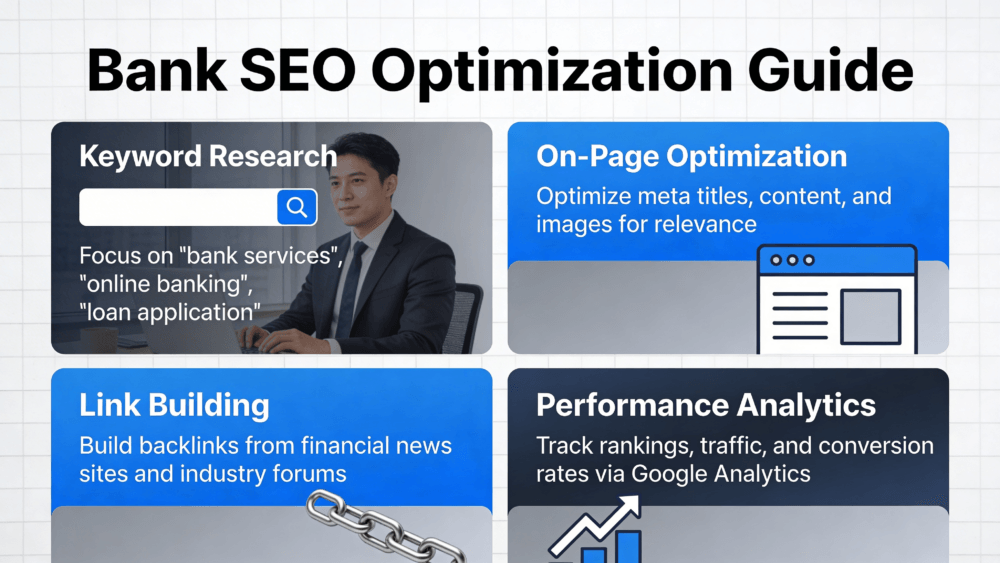
For most banks, the fastest path to better online performance is a practical SEO plan that connects search demand to real business outcomes: qualified traffic, higher conversion rates, and measurable lead generation. A modern bank SEO program blends local SEO, technical SEO, and page SEO with compliance-first content—so your bank website earns visibility without sacrificing customer trust.
JustOctane helps financial institutions turn organic search into a reliable acquisition channel by combining strategy, implementation, and reporting into one continuous optimization cycle.
Contents
- 1 1) What “bank SEO” means in 2025 (and why it’s different)
- 2 2) Local SEO for branches: Google Business Profile + Google Maps
- 3 3) Technical SEO foundations: crawlability, page speed, and Core Web Vitals
- 4 4) Keyword research + user intent: build pages that match how customers search
- 5 5) Content and on-page SEO: a compliant SEO content strategy
- 6 6) Authority building: link building that financial institutions can defend
- 7 7) Measurement, AI, and voice search: what to optimize next
- 8 8) Bank-specific playbooks most SEO guides skip
- 9 FAQ
- 9.1 How does page speed affect a bank website’s rankings and conversions?
- 9.2 What is E‑A‑T and why is it important for banks?
- 9.3 Does structured data (schema) help bank pages, and how should it be used?
- 9.4 How important is local SEO for driving branch visits and local conversions?
- 9.5 What role do backlinks play for bank SEO, and what kind of links matter most?
1) What “bank SEO” means in 2025 (and why it’s different)
Bank SEO is specialized search engine optimization for financial services companies. Unlike general digital marketing, it must balance keywords, conversion-focused copy, and technical performance with regulated disclosures, brand governance, and security expectations. The goal is simple: when potential customers search for banking services, your pages appear in search results because search engines can verify relevance, expertise, and trust signals.
It also helps to remember how rankings started: links and relevance signals shaped early search engine rankings and continue to influence how a search engine evaluates authority.
2) Local SEO for branches: Google Business Profile + Google Maps
Local search is where banks can win quickly—especially community banks competing with national brands. Start by validating every business profile and keeping address phone number details consistent across directories, branch pages, and citations. Then fully optimize your Google Business Profile (also called google business profile) so you can improve local search visibility and appear more often in local search results and the map pack on Google Maps. Add photos, Q&A, and interactive post updates that reflect current services and community priorities.
To attract new customers from nearby intent, publish unique location pages for each branch with services, hours, and locally relevant content. Support this with review workflows (requests, responses, and escalation paths) to strengthen brand visibility and trust without violating compliance.
3) Technical SEO foundations: crawlability, page speed, and Core Web Vitals
Technical SEO work is often the highest-leverage way to improve website performance. Begin with crawlability checks: indexation, redirects, canonical tags, XML sitemaps, and robots rules. Next, fix technical issues that slow down your site on mobile devices—because page speed directly impacts user experience and conversion. Keep templates mobile friendly, minimize pop-ups, and test forms for accessibility.
Use Google PageSpeed Insights and a log-based audit (plus tools like Screaming Frog) to identify render-blocking scripts, heavy tag managers, and image bloat. Prioritize Core Web Vitals, especially on key product pages like checking accounts, cards, and lending applications. Finally, implement schema markup so search engines understand branch entities, services, and FAQs, improving search visibility in rich results.
4) Keyword research + user intent: build pages that match how customers search
Keyword research for banks is not just collecting a list of terms—it’s mapping user intent to the right page type. Separate informational queries (“best savings account” comparisons) from transactional queries (“open checking accounts online”) and navigational queries (login, routing, branch). Long tail keywords are especially valuable because they reflect real decision-making and can reduce competition while still driving qualified traffic.
Combine local search modifiers with product keywords to capture “near me” behavior, and group related keywords into a content plan that avoids cannibalization. When your SEO strategy aligns with intent, marketers can use the same content to support paid campaigns, email, and other digital channels.
5) Content and on-page SEO: a compliant SEO content strategy
Strong content is still the centerpiece of bank SEO, but quality is non-negotiable in the financial industry. Write for a seamless user experience: short sections, clear definitions, and explicit next steps. Where advice can impact finances, include clear disclosures, update dates, and source citations. This approach supports experience, expertise, and trust—signals that matter for both users and search engines.
On the page SEO side, standardize title tags, headings, and internal links so every page has one clear purpose. Keep messaging consistent across product pages and local SEO landing pages, and add secure messaging around privacy, authentication, and fraud prevention.
6) Authority building: link building that financial institutions can defend
Link building remains important, but financial institutions should prioritize brand-safe methods: partnerships with community organizations, digital PR, and thought leadership that earns mentions from reputable financial sites. Done well, authority signals support search rankings and help your bank compete for non-brand queries without relying on risky tactics.
Pair external authority with internal linking so search engines and users can move from educational content to conversion pages. The result is a stronger online presence and more consistent results from organic traffic.
7) Measurement, AI, and voice search: what to optimize next
Modern optimization depends on measurement. Use Google Search Console to monitor clicks, impressions, and query/page pairs, then connect that data to on-site events (form starts, completed applications, calls, and appointments). Track performance by device, location, and session behavior so the team can prove ROI and prioritize the next technical or content fixes.
AI is also reshaping search results, so your content should answer questions directly and consistently. In 2025, SEO strategies that win tend to combine clear answers, strong technical foundations, and trustworthy sources. Build FAQ sections that match voice search patterns, use structured headings, and keep key product information easy to extract. This is how you increase the chance of being cited in Google AI Overviews, featured snippets, and People Also Ask while still serving real customers.
8) Bank-specific playbooks most SEO guides skip
To go beyond generic best practices, add operational playbooks that reduce risk and speed up execution. Examples include: a content approval workflow that aligns marketing with compliance; a merger/branch closure checklist to protect local rankings during rebrands; rate-page governance so APRs, fees, and disclosures stay accurate as offers change; and an indexing policy that keeps sensitive online banking areas out of search while promoting public product content. If your bank is consolidating branches, plan redirects and on-page messaging so customers (and search engines) understand what moved, what closed, and what remains available locally.
If you want a bank SEO agency that can execute these details end-to-end, JustOctane acts as a specialized SEO agency for banks—delivering audits, roadmaps, implementation, and ongoing reporting to attract new customers and improve local search, search engine rankings, and long-term lead generation. If you’re ready for a practical plan (not theory), ask JustOctane for a bank SEO audit that prioritizes quick technical wins, high-intent keywords, and compliant content updates.
FAQ
How does page speed affect a bank website’s rankings and conversions?
Page speed directly affects both user behavior and search visibility. Research from Google and industry performance studies show a large share of mobile visitors abandon pages that load slowly (commonly reported: many leave after ~3 seconds), and Google’s Core Web Vitals (Largest Contentful Paint, Cumulative Layout Shift, and Interaction responsiveness metrics) are part of the page‑experience signals that influence ranking. Faster pages reduce bounce, improve user engagement, and—across many case studies—raise conversion rates for financial sites that depend on form completions and branch/digital sales. In practice, optimizing images, server response times, caching, and minimizing third‑party scripts produces measurable lifts in both organic visibility and conversion.
What is E‑A‑T and why is it important for banks?
E‑A‑T stands for Expertise, Authoritativeness, and Trustworthiness. It comes from Google’s Quality Rater Guidelines and is especially important for YMYL (Your Money or Your Life) content such as banking, loans, and investment advice. Research and guideline analyses show pages demonstrating strong expertise (qualified authors), authoritativeness (reputable site and external recognition), and trustworthiness (clear policies, secure site, accurate content) are treated more favorably by quality raters and tend to perform better in search. For banks, that means using qualified author bylines, clear disclosures, up‑to‑date product info, and robust security/privacy signals to reduce risk of ranking downweights or low user trust.
Does structured data (schema) help bank pages, and how should it be used?
Structured data helps search engines interpret page content and can enable enhanced results (rich snippets) that increase click‑through rates. Empirical analyses across multiple sites find that properly implemented schema for items such as Organization, FinancialProduct/Service, FAQPage, LocalBusiness/Branch, breadcrumbs, and review snippets can improve SERP visibility and CTR. For banks, applying accurate schema to branch locations, product pages (e.g., “mortgage” or “savings account”), FAQs, and corporate details improves how search engines present information and reduces ambiguity in indexing.
How important is local SEO for driving branch visits and local conversions?
Local search signals strongly influence foot traffic and local conversions. Industry ranking‑factor studies and Google’s own local search documentation identify proximity, Google Business Profile completeness, consistent NAP (name/address/phone) data, user reviews, and on‑page local content as top local ranking signals. For physical bank branches, maintaining an accurate business profile, soliciting and responding to reviews, ensuring citations are consistent across directories, and optimizing branch pages for local keywords measurably increases visibility in the local pack and drives more calls/visits.
What role do backlinks play for bank SEO, and what kind of links matter most?
Backlinks remain a major correlate of organic ranking in numerous large‑scale SEO studies. However, quality and relevance matter far more than raw link count: links from authoritative, topically relevant sources (industry publications, government/education sites, reputable financial news, local business partners) carry more value than many low‑quality links. Research and Google’s algorithm updates (and manual actions) show that unnatural or spammy link patterns can lead to penalties. For banks, the evidence‑backed approach is to earn high‑quality, editorial links via trustworthy content, data releases, research, local partnerships, and PR rather than pursuing mass, low‑quality link schemes.