

Insurance seo strategies for agencies: local visibility, content, reviews, and technical optimization
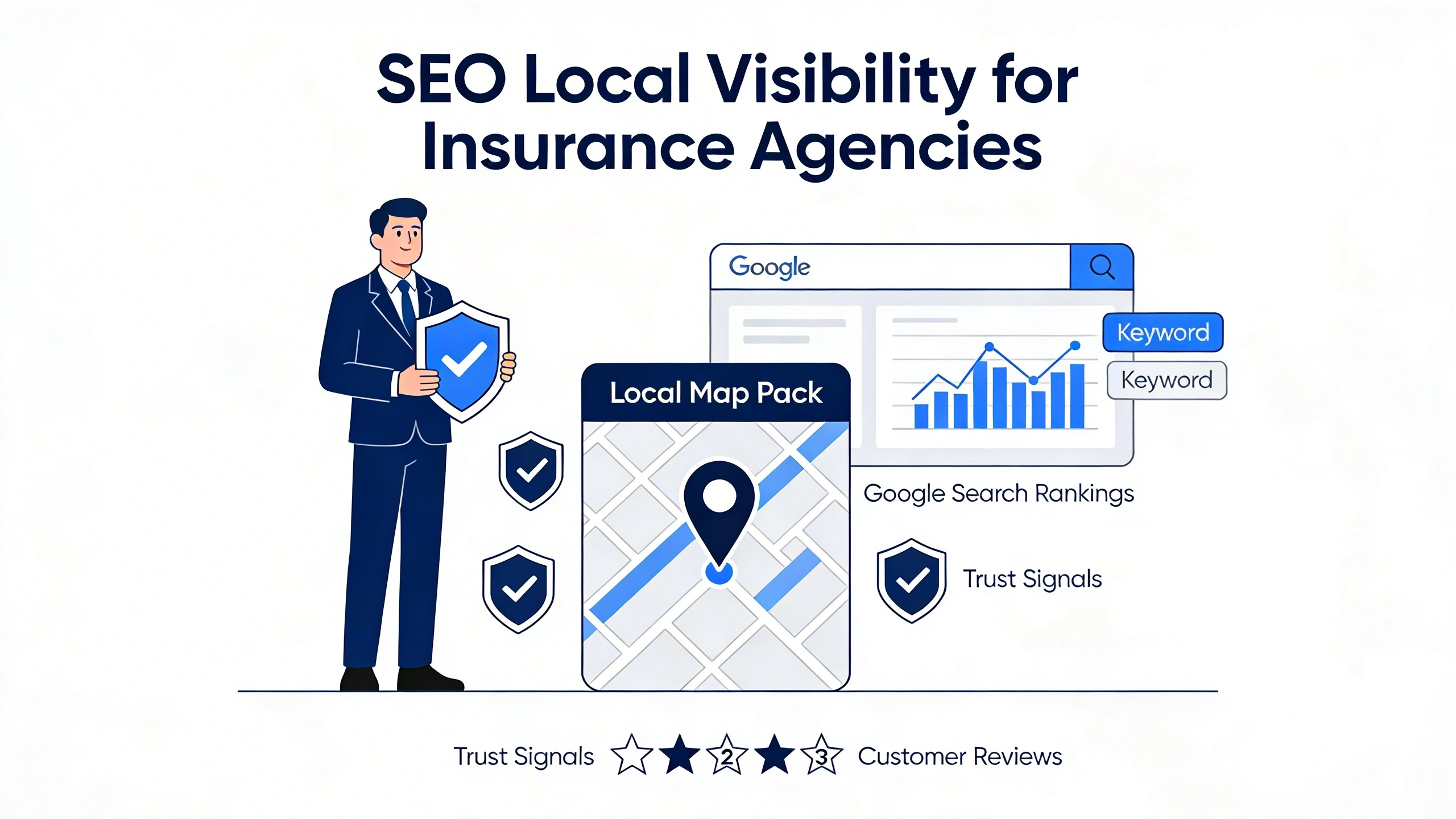
Insurance SEO is the practice of improving an insurance agency website so it earns better search results on Google and other search engines, then turns that online traffic into calls, forms, and booked appointments. Whether you run an independent agency or work with insurance companies, your prospects are already in an online search mindset—comparing coverage, pricing, and trust signals before they contact agents.
The goal isn’t to chase a single keyword. It’s to build a marketing strategy that search engines understand, people like, and potential clients want to engage with. To leverage search engine visibility, publish clear answers for potential clients searching by coverage type, location, and urgency—so your agency online presence becomes a durable, long term growth channel.
Contents
- 1 1) What insurance SEO is (and what search engines measure)
- 2 2) Build the foundation: site structure, indexability, and technical choices
- 3 3) On-page optimization: meta titles, headings, and intent
- 4 4) Local search presence: Google Business Profile, reviews, and trust
- 5 5) Conversion, compliance, and accessibility (insurance-specific)
- 6 6) Keywords, content, and service pages that attract website visitors
- 7 7) Authority signals: links, citations, and brand consistency
- 8 8) AI-driven search: make your pages answer-ready
- 9 9) Measurement that connects marketing to revenue
- 10 10) A practical 90-day plan to improve visibility
- 11 11) Where JustOctane fits: SEO strategy, execution, and accountability
- 12 Five research-backed questions & answers
- 12.1 Why is E‑E‑A‑T (Experience, Expertise, Authoritativeness, Trustworthiness) important for insurance websites?
- 12.2 How does page speed impact conversions on insurance sites?
- 12.3 Which on-page content elements most increase consumer trust for insurance offers?
- 12.4 How do backlinks affect search rankings for insurance websites?
- 12.5 How important are local reviews for an insurance agency’s visibility and customer acquisition?
1) What insurance SEO is (and what search engines measure)
At its core, search engine optimization is about relevance and confidence. Search engines use crawlers to discover each page on your site, interpret content and intent, and decide which results best match a search. When your pages clearly explain insurance terms, match the questions customers ask, and demonstrate credibility, you’re more likely to appear in higher search results.
Google’s own documentation emphasizes building helpful pages for users rather than trying to “game” the engine. See “Search Engine Optimization (SEO) Starter Guide”.
For seo insurance companies teams and for seo insurance agents at local firms, the same fundamentals apply: be findable, be useful, and be trustworthy across the website and across platforms like Google, Reddit, and YouTube.
2) Build the foundation: site structure, indexability, and technical choices
Before you publish more content, confirm that your site is easy for search engines to crawl. A clean architecture helps insurance agencies SEO because it reduces confusion about what your agency does, where you operate, and which lines of business you prioritize.
Start with technical basics (these are simple, but they matter): a logical URL structure, a sitemap, correct robots rules, and consistent canonical signals. This is the unglamorous side of engine optimization, but it’s often the difference between pages being discovered quickly—or being ignored.
Technical work also supports the user experience. If pages are slow, unstable, or hard to navigate on mobile, people leave, and your visibility can fall. Treat technical SEO as part of your optimization SEO stack, follow seo best practices, and remember that “search engine optimization” is often shortened in conversation to engine optimization SEO.
3) On-page optimization: meta titles, headings, and intent
On-page SEO helps search engines understand what each page is about and helps prospects choose you in the search engine results. Make your titles specific to a service and a location, and write like a human—because customers can spot generic, generated content fast.
A practical standard: align titles meta descriptions with the promise of the page. For example, a page targeting auto insurance should discuss quotes, coverage limits, deductibles, claims steps, and what to bring to the call. A page targeting life insurance should cover term vs whole, underwriting basics, beneficiaries, and how to compare carriers.
This is also where “seo insurance” work becomes measurable: better meta titles and clearer pages typically increase click-through rate, which leads to more prospects entering your funnel even if your rank doesn’t change overnight.
4) Local search presence: Google Business Profile, reviews, and trust
For most agencies, local search is the fastest path to qualified leads. Your local search presence depends on your Google Business Profile, consistent name/address/phone data, relevant categories, and proof that real people choose your business.
Reviews are a major driver of both conversion and rankings because they function as user generated content. Create a simple follow-up workflow after a policy is bound or a claim is resolved, and make it easy for satisfied clients leave feedback. Over time, that’s how clients leave reviews consistently—without awkward, one-off asks.
Don’t ignore review responses. Thoughtful replies help future customers feel understood, and they reinforce your insurance agency digital presence as responsive and professional.
5) Conversion, compliance, and accessibility (insurance-specific)
Insurance websites don’t just need traffic—they need trust. Because insurance is regulated, your content and offers should be accurate, avoid misleading rate guarantees, and match what your agents can actually deliver. Add clear licensing details, explain how you handle personal data, and make it obvious how customers can contact you (call, form, or appointment) without friction.
For measurement, go beyond “visits.” Set up GA4 events for phone clicks and form submissions, and connect those leads to your CRM so you can see which page and which keyword drove the policy. This closes the loop between SEO and revenue in a way most competitors don’t implement.
Finally, don’t overlook accessibility: make forms usable with keyboard navigation, add descriptive labels, and ensure key content is readable on mobile. These improvements reduce drop-offs and help every prospective customer interact with your site.
6) Keywords, content, and service pages that attract website visitors
Keyword research isn’t just a list of head terms. It’s understanding what people search at each stage: “near me” discovery, comparison shopping, and urgent questions after an incident. Build content around those needs and map them to pages that convert.
For insurance agencies and insurance agents brokers, that usually means a blend of: core service pages, location pages, and supporting articles. For insurance companies agents and brokers teams, it often includes deeper product education and comparison pages that demonstrate expertise.
Two rules that keep your seo efforts from drifting: (1) write one strong, comprehensive page per topic before you publish five thin pages, and (2) use internal linking to connect related pages so search engines understand topical depth. Done well, this organic search approach helps you attract website visitors and improves organic search engine visibility for the topics you actually want to win.
7) Authority signals: links, citations, and brand consistency
Authority is where many insurance companies and independent agencies get stuck. You can have great content, but if your brand looks inconsistent across the internet, prospects hesitate and search engines lower confidence.
Build a consistent footprint in local directories, industry associations, and partner sites. Earn backlinks from relevant websites, not random lists. Keep your agency online mentions aligned (same name, phone, address), and connect them to your site with clear “about” and “contact” pages.
If you represent mutual insurance carriers or multiple carriers, clarify that relationship. Customers want to know whether you’re captive or independent, and that transparency improves trust and helps your page convert.
8) AI-driven search: make your pages answer-ready
AI is changing how results are presented, but the fundamentals still apply: clarity, accuracy, and helpful structure. In practice, “answer-ready” content uses short definitions, question-based subheads, and examples that match real customer language.
Modern systems rely on patterns of meaning. A widely cited example is “BERT: Pre-training of Deep Bidirectional Transformers for Language Understanding”. The takeaway for an insurance agency: use consistent terminology (policy, premium, deductible, liability), and don’t bury the answer.
Be careful with AI-assisted writing. It can speed up drafts, but it can also produce mistakes that harm trust. Use tools like AI for outlines, then have a licensed reviewer edit and add local details. That approach protects quality while still letting your team scale content.
9) Measurement that connects marketing to revenue
Good SEO help requires measurement. Use Google Search Console to monitor impressions and clicks for priority pages, then pair it with analytics and call tracking to understand which searches create real leads. This is where many agencies miss the biggest opportunity: they look at traffic, but not at which page produces qualified calls.
Track a few business-focused metrics: organic search conversions by line of business, form completion rate, call quality, and close rate by source. When you find a page that converts, expand it and improve the offer (clear contact options, fast quote flow, and next-step guidance). That’s how agencies rank higher over time without relying on gimmicks.
10) A practical 90-day plan to improve visibility
If you need a simple framework, use this sequence. It works for a single-location agency local search campaign and for multi-location insurance companies:
- Weeks 1–2: Fix technical issues, indexing, and site structure so search engines can crawl and understand your pages.
- Weeks 3–4: Rewrite core pages (auto insurance, life insurance, and other priority services), improve meta titles, and tighten internal links.
- Weeks 5–8: Build local proof: optimize your Google Business Profile, improve local search presence, and implement a review process so satisfied clients leave testimonials.
- Weeks 9–12: Publish supporting content targeting insurance terms and questions, earn relevant backlinks, and refine conversion paths.
This is the kind of seo strategy that compounds: each improvement makes the next one more effective, and your agency digital presence becomes harder for competitors to copy.
11) Where JustOctane fits: SEO strategy, execution, and accountability
If you want to move faster, JustOctane (an SEO company focused on performance marketing) helps insurance agencies build an end-to-end system—technical SEO, content strategy, local search optimization, and reporting—without guessing. We start by analyzing what’s already ranking in your market, identify gaps, and then prioritize changes that improve conversions, not just rankings. The goal is to make SEO accountable to sales outcomes, not vanity metrics.
That includes practical work like cleaning up meta titles, strengthening service pages, improving review velocity, and building a defensible content plan that doesn’t rely on low-quality generated content. It also means setting expectations: SEO is long term, but with consistent execution, it becomes one of the most cost-effective digital marketing channels an agency can own.
If you’d like, JustOctane can run a quick audit of your site, your Google Business Profile, and your current search results to show exactly what to fix first—and what to ignore.
Five research-backed questions & answers
Why is E‑E‑A‑T (Experience, Expertise, Authoritativeness, Trustworthiness) important for insurance websites?
Insurance is a YMYL (Your Money or Your Life) topic, so search engines and human raters emphasize content quality and trustworthiness. Google’s Search Quality Rater Guidelines highlight E‑E‑A‑T as a critical assessment factor for YMYL pages; sites that demonstrate clear author credentials, accurate sourcing, and transparent policies are less likely to be downgraded by quality raters and are more likely to rank and convert users (Google Search Quality Rater Guidelines). In practice, E‑E‑A‑T reduces perceived risk for users making high‑stakes financial decisions.
How does page speed impact conversions on insurance sites?
Fast-loading pages materially affect user behavior and conversions. Google research shows a large share of mobile visitors abandon pages that take longer than three seconds to load, which directly reduces lead generation and quote starts (Google research on mobile page speed). Additionally, Google’s Core Web Vitals (introduced as ranking signals) link user experience metrics (loading, interactivity, visual stability) to search performance; improving these metrics tends to increase engagement and conversion rates.
Which on-page content elements most increase consumer trust for insurance offers?
Usability and credibility studies show several on‑page elements consistently raise trust: visible author/agent credentials and licensing, clear contact information (phone, local address), prominent privacy/security signals (SSL, privacy policy), transparent policy summaries and exclusions, and verifiable customer testimonials. Classic web‑credibility research (Stanford’s Web Credibility studies, Fogg et al.) found that design clarity, easily verifiable facts, and professional presentation strongly influence perceived credibility—especially for high‑risk purchases like insurance.
How do backlinks affect search rankings for insurance websites?
Multiple large analyses find a strong correlation between the number and quality of referring domains and higher organic rankings. For insurance sites, high‑quality, topically relevant links (industry partners, local business organizations, authoritative publications) are far more valuable than many low‑quality links. Note also that search engines penalize manipulative link practices (e.g., link spam), so focus on earning relevant, authoritative links.
How important are local reviews for an insurance agency’s visibility and customer acquisition?
Local ranking studies and consumer surveys show reviews influence both search visibility and consumer choice. Local ranking factor research consistently ranks review signals and Google Business Profile factors among the top local ranking influences. Consumer research shows that prospective customers actively read and rely on reviews when selecting local service providers. Practical implications: systematically collect and respond to reviews, maintain accurate local business listings, and prioritize review quality and recency to improve both rankings and conversion rates.