

7 best ecommerce platforms for seo: features, pricing, and risks (shopify, woocommerce, bigcommerce, magento + more)
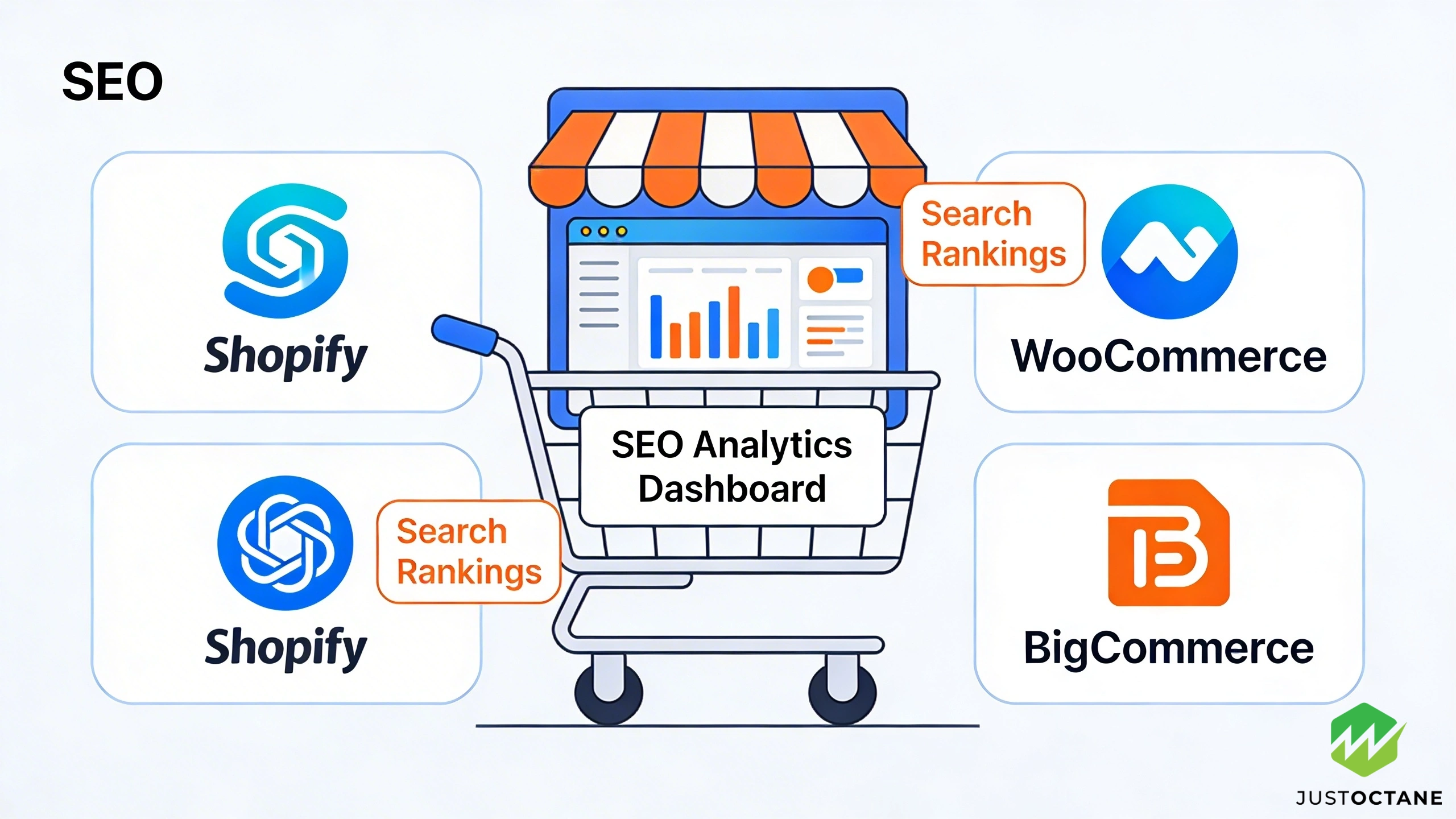
Choosing an ecommerce platform isn’t just a design decision it sets the ceiling for your SEO, your technical optimization options, and how quickly your team can ship improvements that impact visibility, traffic, and revenue. The goal isn’t to find a single platform best SEO choice; it’s to pick the right ecommerce platform for your business model, your content strategy, and your customization bandwidth.
If you want a second set of eyes on platform SEO tradeoffs (before you commit to a migration or rebuild), JustOctane can map requirements to the platform and the SEO tools you actually need.
Contents
- 1 1) What “SEO” means for an ecommerce website
- 2 2) The key SEO features to compare across ecommerce platforms
- 3 3) The 7 best ecommerce platforms for SEO (pros, cons, and who they fit)
- 4 4) A decision framework to ensure ecommerce platform fit
- 5 5) Advanced ecommerce SEO issues many guides skip
- 6 6) Replatforming without losing rankings
- 7 7) Where JustOctane fits in
- 8 Five new science-backed questions & answers
1) What “SEO” means for an ecommerce website
SEO for an ecommerce site is the combination of technical setup and on-page work that helps search engines understand your website and rank your product pages, category pages, and supporting content in search engine results. Google’s guidance in “SEO Starter Guide: The Basics” reinforces the basics: clear site structure, helpful pages, and a user friendly experience across mobile and desktop.
In practice, ecommerce SEO succeeds when you can control urls, publish content consistently, and keep the store fast enough that user experience doesn’t collapse under marketing pressure.
2) The key SEO features to compare across ecommerce platforms
When you compare ecommerce platforms SEO features, focus on the key features you can reliably control at scale (without fragile workarounds). Strong SEO capabilities usually come down to a few repeatable best practices:
- URL and metadata control: editable urls, friendly urls, SEO friendly urls, and templated meta tags for large catalogs (so “meta” and “tags” don’t become a manual nightmare).
- Indexation + duplication safeguards: canonical logic, parameter handling, and rules that prevent thin pages from competing with your best ecommerce landing pages.
- Performance: fast loading times, stable hosting, and mobile performance that supports search engine rankings.
- Content + marketing workflow: built-in blogging or a clean integration with WordPress/CMS so your digital marketing team can publish content that supports product pages.
- Tooling: practical SEO tools, analytics hooks, and the ability to implement structured data without breaking themes.
Hosted options often ship with built SEO features out of the box; open source stacks can be more flexible, but the team and process matter more than the platform alone.
3) The 7 best ecommerce platforms for SEO (pros, cons, and who they fit)
Below are popular ecommerce platforms Shopify brands shortlist repeatedly, including platforms Shopify, WooCommerce, BigCommerce, and Magento. Each ecommerce platform has tradeoffs in pricing, customization, and long-term platform SEO control.
Shopify
For many businesses, Shopify is the shopify best starting point: a hosted ecommerce platform with strong defaults, built-in tooling, and solid performance. As an ecommerce platform Shopify makes it easy to launch an online store, manage product pages, and handle basic optimization without deep dev work.
Pro: dependable performance, a user friendly admin, and predictable releases. Con: certain url structure constraints can limit very advanced customization for large ecommerce brands.
WooCommerce (WordPress)
WooCommerce is often the woocommerce best option when content is a growth engine and you want open source flexibility. Because it runs on WordPress, it’s strong for content marketing, internal linking, and granular control over templates.
Pro: deep customization and a huge plugin ecosystem. Con: you own hosting, updates, and performance so “free” software can still have real total cost.
BigCommerce
BigCommerce is a hosted platform that fits mid-market stores that need strong built-ins, multi-channel support, and less maintenance overhead than self-hosted stacks. In many BigCommerce Magento comparisons, BigCommerce wins on simplicity, while Magento wins on deep control.
Pro: solid out-of-the-box SEO features and integrations. Con: advanced edge cases (filters, parameters) still require careful planning.
Magento (Adobe Commerce)
Magento also called Adobe Commerce is built for complex commerce: large catalogs, multi-store setups, and advanced rules. It’s ideal when you need full control over platform SEO, but it usually requires a dedicated team.
Pro: enterprise-grade customization and long-term flexibility. Con: higher implementation and maintenance pricing.
Wix eCommerce
Wix is a website builder that has improved its ecommerce SEO options. It can be a practical platform for smaller businesses that want fast setup, mobile-ready themes, and a simpler path to basic SEO friendly configuration.
PrestaShop
PrestaShop is an open source commerce platform with a large marketplace of modules. It can be a good fit if your business wants flexibility and is comfortable managing technical upkeep.
Squarespace Commerce
Squarespace is best known for design, but Squarespace Commerce can work for smaller catalogs where visual branding and a clean website experience matter as much as advanced SEO tools.
In real-world evaluations, Shopify WooCommerce BigCommerce and WooCommerce BigCommerce Magento are the most common “shortlist clusters” then the best ecommerce platform becomes whichever aligns with your operations and growth targets.
4) A decision framework to ensure ecommerce platform fit
If you’re trying to decide which ecommerce platform best matches your situation, start with constraints. In SEO ecommerce projects, the platform choice sets your ceiling and every SEO ecommerce platform decision should start with what you can control, automate, and maintain. The ecommerce platform best for you is the one your team can maintain while consistently publishing content and running optimization experiments.
Ask three questions:
First, do you need hosted simplicity or open source control? Second, what level of customization is required for your catalog and marketing workflows? Third, can you protect performance as the business scales?
There’s no universal best ecommerce platform SEO checklist that overrides reality. Instead, pick the platform that gives you enough control over meta tags, urls, and pages to compete in search engines without slowing your team down.
5) Advanced ecommerce SEO issues many guides skip
Most “best ecommerce platforms” posts stop at surface-level SEO features. The harder wins come from how your platform handles real ecommerce problems:
Faceted navigation and crawl waste: filter combinations can create thousands of near-duplicate pages. You need a plan for canonicals, noindex rules, and internal links so the pages that matter earn visibility.
Internationalization: if you sell across regions, you’ll eventually need a strategy for language/currency URLs, hreflang, and multi-store architecture.
JavaScript and headless builds: headless commerce can be great, but rendering choices (SSR vs CSR) impact how search engines discover content. You want performance and control, not surprises.
Structured data at scale: product schema, breadcrumbs, and organization markup help search engine results stand out especially when competitors are feature-complete.
These are the areas where an experienced ecommerce SEO agency can turn “SEO friendly ecommerce” into measurable growth.
6) Replatforming without losing rankings
Platform migrations fail when teams treat them like design projects instead of technical SEO projects. Keep these best practices in place before launch:
- Map old urls to new urls and test 301 redirects in a staging site.
- Validate canonicals, meta tags, and indexation rules for key pages.
- Regenerate sitemaps, monitor crawl behavior, and review search engine results for drops.
- Confirm mobile speed, fast loading times, and Core Web Vitals to protect search engine rankings.
After launch, measure impact the same way you’d QA a release: monitor Google Search Console for coverage and indexing, run a crawl to confirm internal links, and spot-check server logs so you can see how search engines are actually spending crawl budget.
If you want the research view of why link structure still matters, revisit “The Anatomy of a Large-Scale Hypertextual Web Search Engine”. Even modern AI-driven search still relies on clean architecture and signals.
7) Where JustOctane fits in
Platforms are only half the equation. JustOctane helps businesses turn ecommerce SEO into a repeatable system: technical audits, content planning, and ongoing optimization tied to conversions. Whether you’re on Shopify, WooCommerce, BigCommerce, Magento, or another ecommerce store setup, our team builds a platform SEO roadmap that matches your resources and your goals.
If you’re stuck between “ecommerce platform SEO” options, or you’re planning a migration and want to protect traffic, talk to JustOctane. We’ll help you choose the best ecommerce platform, align tools and workflows, and ship changes that improve visibility in search engines.
To get a platform recommendation and an implementation plan, request a quick ecommerce SEO audit from JustOctane.
Five new science-backed questions & answers
1. How does sleep affect memory consolidation?
Sleep is an active component of memory consolidation: slow‑wave sleep (deep sleep) helps stabilize and transfer declarative memories (facts/events) from the hippocampus to cortical storage, while REM sleep is implicated in procedural and emotional memory processing. Randomized and controlled studies plus mechanistic reviews show that sleeping after learning reliably improves retention and performance compared with equivalent periods awake (Diekelmann & Born, 2010; Walker, 2009). In short, getting adequate sleep after studying or skill practice measurably boosts memory consolidation.
2. Can regular exercise reduce symptoms of depression?
Yes. Multiple randomized trials and meta‑analyses find that regular physical activity both aerobic and resistance training produces moderate reductions in depressive symptoms and can be an effective adjunctive treatment. Proposed mechanisms include increases in brain‑derived neurotrophic factor (BDNF), reductions in systemic inflammation, endorphin and monoamine changes, and psychosocial benefits of activity. Systematic reviews (e.g., Cochrane-style analyses) report consistent benefit, though effect size varies by study quality, exercise dose, and population.
3. How effective is handwashing at preventing infections?
Handwashing with soap is one of the most well‑established, low‑cost interventions for reducing infectious disease. Systematic reviews and public‑health evaluations show handwashing programs lower diarrheal disease incidence substantially (commonly reported reductions in the range of ~30–50%) and reduce respiratory infections to a lesser but meaningful extent. Effectiveness depends on adherence, technique, and context, but the overall evidence supports handwashing as a major preventive measure.
4. Do probiotics help prevent antibiotic‑associated diarrhea?
Evidence from randomized trials and systematic reviews indicates that certain probiotic strains can reduce the risk of antibiotic‑associated diarrhea, including some reductions in Clostridioides difficile–associated disease. The magnitude of benefit varies by probiotic strain, dose, timing relative to antibiotics, and patient group. Clinical guidelines and Cochrane‑style reviews conclude there is a modest protective effect overall, but recommendations emphasize selecting strains with demonstrated efficacy and exercising caution in severely immunocompromised patients.
5. Does evening use of light‑emitting screens affect sleep?
Yes. Evening exposure to light from phones, tablets, and e‑readers suppresses melatonin production, delays circadian timing, increases time to fall asleep, and can reduce sleep quality and next‑day alertness. Experimental studies comparing reading on light‑emitting devices versus non‑emitting paper found measurable delays in melatonin onset and shorter/poorer sleep after device use (e.g., Chang et al., 2015). Limiting screen exposure in the hour or two before bedtime, lowering screen brightness, or using night‑shift/blue‑light reduction settings can reduce these effects.