

Accountants & SEO: Build a Search Strategy That Ranks Your Accounting Firm Website and Brings Leads
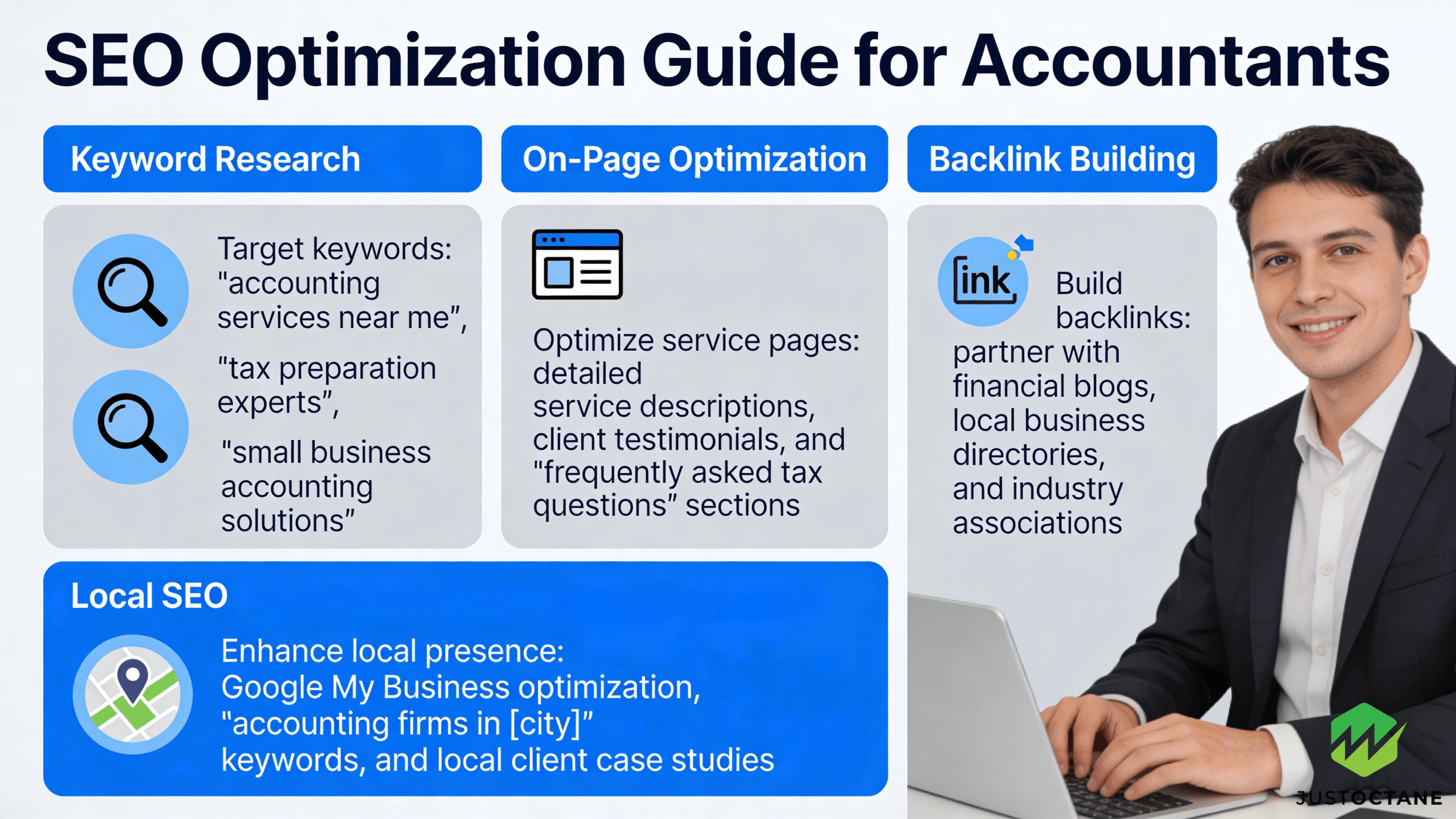
Referrals will always matter in accounting, but most prospects now start with search. Search engine optimization is the work of making your website visible when people look for the services you offer. Picture potential clients searching for help, scanning engine results pages, and choosing the firm that looks credible and convenient.
This guide breaks down the core seo strategies that consistently work for accountants: keyword research, content, technical optimization, and authority. It also includes practical steps you can implement yourself, plus the “behind the scenes” approach JustOctane uses to turn seo into predictable leads for accounting firms.
Contents
- 1 1) Start with an SEO strategy tied to revenue (not “more traffic”)
- 2 2) Keyword research: translate “what you offer” into search terms prospects use
- 3 3) Content that earns trust: service pages + supporting content
- 4 4) On-page SEO: help search engines understand every page
- 5 5) Local SEO: win the map pack with Google Business Profile
- 6 6) Technical SEO and user experience: remove friction that blocks rankings
- 7 7) Authority: earn inbound links with real expertise
- 8 8) AI search optimization: future-proof your seo without chasing hype
- 9 9) Choosing seo services: what good “seo accounting” looks like
- 10 10) Measure what matters: rankings, leads, and sales pipeline
- 11 How JustOctane helps accountants rank faster (and convert more)
- 12 FAQ
1) Start with an SEO strategy tied to revenue (not “more traffic”)
The fastest way to waste time in marketing is to chase rankings for broad terms that don’t convert. A strong seo strategy starts with your services and your client profile, then maps each service to a dedicated page on your site.
For most accounting firms, that means separate conversion-focused pages for tax, bookkeeping, payroll, and advisory—each page optimized around one primary keyword, supported by relevant keywords and related content. When each page has one job, it becomes easier to optimize, measure, and improve.
Ask: which services produce the best long-term clients and the most predictable workflow? Prioritize those first, then expand into adjacent accounting services as you build authority and visibility.
2) Keyword research: translate “what you offer” into search terms prospects use
Keyword research is where you learn the exact language people use when searching accounting services. Start with seed keywords (for example: “tax accountant,” “CPA,” “bookkeeping”), then expand using tools, SERP reviews, and the google auto-suggest feature in Google search.
Then study google search results and search engine results in your market. What’s ranking: service pages, local landing pages, or educational content? That mix tells you what the search engine believes satisfies intent and what search engines understand as the “best next click.”
Finally, build a simple keyword map: assign one primary keyword to each page, then list secondary terms to use naturally in headings, body copy, and internal links.
3) Content that earns trust: service pages + supporting content
Most seo accountants struggle because their content is thin: a few paragraphs, generic claims, and no depth. Instead, build a content system that mirrors how potential clients evaluate accounting firms. Use your core service pages as the hub, then publish supporting content that answers real questions.
Examples include: “What documents do I need for tax filing?”, “Bookkeeping vs. accounting: what’s the difference?”, or “How to choose monthly accounting for a small business.” This approach helps your site rank for more search terms while reinforcing topical relevance.
Done well, content becomes your best salesperson: it builds trust before the call, filters out bad-fit leads, and increases conversion rates from organic traffic.
4) On-page SEO: help search engines understand every page
On-page optimization is how you make each page search engine optimized for both users and search engine crawlers. That includes title tags, headings, internal links, and meta descriptions that reflect real search terms without sounding spammy.
For a useful reference on “title links” (what many people call the title in results), see “Influencing your title links in search results” (Google Search Central).
A practical rule: if you can remove a paragraph without changing meaning, add specifics. Mention your process, industries, and deliverables. Make it easy for search engines to interpret your page and for clients to take the next step.
5) Local SEO: win the map pack with Google Business Profile
Local seo is often the highest ROI channel for accountants because it captures high-intent searches close to the moment of decision. Your google business profile is the center of this effort, but it only works when your business profile is complete, accurate, and supported by your website.
Local search visibility also depends on trust signals around proximity and prominence, so keep your listings accurate and your on-site location signals consistent.
To improve local seo services performance, keep your name, address, and phone number consistent; choose the right categories; add services; post updates; and collect reviews. Then connect everything with location-focused pages and localized content that matches the cities you serve.
If you’re virtual or hybrid, be careful with service-area settings and messaging so you don’t confuse clients (or the algorithm) about where you can actually deliver services.
6) Technical SEO and user experience: remove friction that blocks rankings
Technical seo is about making sure your accounting website is crawlable, fast, and easy to use. Page load speed affects user experience, and it can influence how search engines evaluate your site during ranking tests.
Prioritize the basics: mobile usability, secure hosting, clean URL structure, indexation controls, and structured data. Beyond page load speed, monitor Core Web Vitals (LCP, INP, and CLS) so your pages stay fast and stable on mobile. For structured data, many firms can use LocalBusiness or ProfessionalService schema, and add FAQPage schema where it truly answers client questions. For multi-location firms, also manage duplicate or thin pages so you don’t dilute relevance across cities.
One unique angle for accounting: protect trust. Avoid intrusive pop-ups on key pages, keep forms secure, and don’t publish sensitive client details in case studies—an easy way to lose credibility even if you gain traffic.
7) Authority: earn inbound links with real expertise
Link building is still a major factor because backlinks and inbound links act like independent “votes” that validate your credibility.
In practice, you earn links by publishing truly useful content (templates, calculators, checklists), contributing insights to journalists, and building relationships with local organizations. Avoid low-quality directory blasts—focus on relevant sites in finance, local business, and the industries you serve.
8) AI search optimization: future-proof your seo without chasing hype
AI is reshaping how results are assembled, summarized, and clicked. AI search optimization doesn’t replace fundamentals; it rewards clarity and specificity. Use short definitions, simple examples, and FAQ-style formatting so search engines understand your expertise and can summarize it accurately.
To compete in ai search, refresh key pages regularly, add first-hand insights, and improve internal links between service pages and supporting content. Share examples without breaking client confidentiality. This is also where many seo services accountants buy fall short: they publish generic articles that look like everyone else’s and fail to differentiate your firm.
9) Choosing seo services: what good “seo accounting” looks like
If you’re comparing providers, don’t just ask for “engine optimization” deliverables. Ask what the provider will do to improve visibility, rankings, and leads—then ask how they’ll prove it.
High-quality seo accounting firms invest in looks like this: clear keyword research, content that matches intent, and technical fixes that remove crawl issues. Whether you hire in-house, use freelancers, or work with a seo agency accountants can rely on, you should see a documented plan for each page, plus a timeline for results.
Also look for industry fit. An accounting firm seo campaign should reflect seasonality (tax deadlines), compliance language, and the reality that trust signals matter as much as traffic.
10) Measure what matters: rankings, leads, and sales pipeline
SEO without measurement becomes “hope marketing.” Track keyword rankings and organic traffic, but also track calls, form submissions, and booked consultations. Set up Google Search Console (google search console) to monitor indexing and queries, then use analytics to measure performance.
For better attribution than “last click,” add GA4, use UTM parameters on profile links and campaigns, and consider privacy-friendly heatmaps (with consent mode) to identify where users get stuck. This makes it easier to improve pages that already rank and turn more traffic into leads.
How JustOctane helps accountants rank faster (and convert more)
JustOctane, an SEO company for accountants, works with accountants who want consistent leads from search, not a one-time spike. We combine content, technical seo, and authority into a single operating system that compounds over time.
Our approach is straightforward: audit your accounting firm website, identify quick wins, build a keyword-driven content plan, and implement on-page improvements (title tags, meta descriptions, internal links) so every page is built to rank and convert. Then we support that foundation with link building and digital PR to earn relevant backlinks.
If you want an actionable plan, contact JustOctane for a focused review of your site and a roadmap to improve visibility, rankings, and leads—without guesswork.
FAQ
How long does SEO take to show results?
There is no fixed time, but multiple industry analyses and practitioner experience show SEO commonly takes months to move meaningful metrics — typically 4–12 months for measurable organic traffic gains for a new or competitive site. Time-to-results depends on starting domain authority, keyword difficulty, content quality, technical health, and the consistency of optimization and link-building efforts. (See long-form experiments and practitioner guidance for typical timelines.)
Do backlinks still matter for SEO?
Yes. Empirical correlation studies and statements from Google show links remain one of the strongest ranking signals: pages with more high-quality, relevant backlinks generally rank higher. Quality and topical relevance matter far more than raw link count — spammy or manipulative links can harm rankings, while authoritative, relevant links help signals of trust and relevance.
Does page speed and Core Web Vitals affect rankings?
Yes. Google announced Core Web Vitals and the Page Experience signals as ranking influences; slow pages and poor user experience can reduce visibility. Page speed is often a small-but-measurable ranking factor and also affects user engagement (bounce and conversion), which indirectly influences SEO performance.
Source: Google — Page Experience & Core Web Vitals
Does HTTPS improve SEO?
HTTPS is a confirmed lightweight ranking signal according to Google, and using HTTPS is considered best practice for security, user trust, and referral data preservation. Migrating to HTTPS can remove mixed-content issues and preserve analytics/referrer information, so it helps both ranking signal and practical measurement.
Research and official Google statements indicate social signals (likes, shares) are not direct ranking factors. However, social media can indirectly help SEO by increasing content visibility, driving traffic, and generating earning opportunities for links and brand searches — all of which can improve organic performance.