

SEO for photographers: optimize your photography website to rank, attract clients, and book more sessions
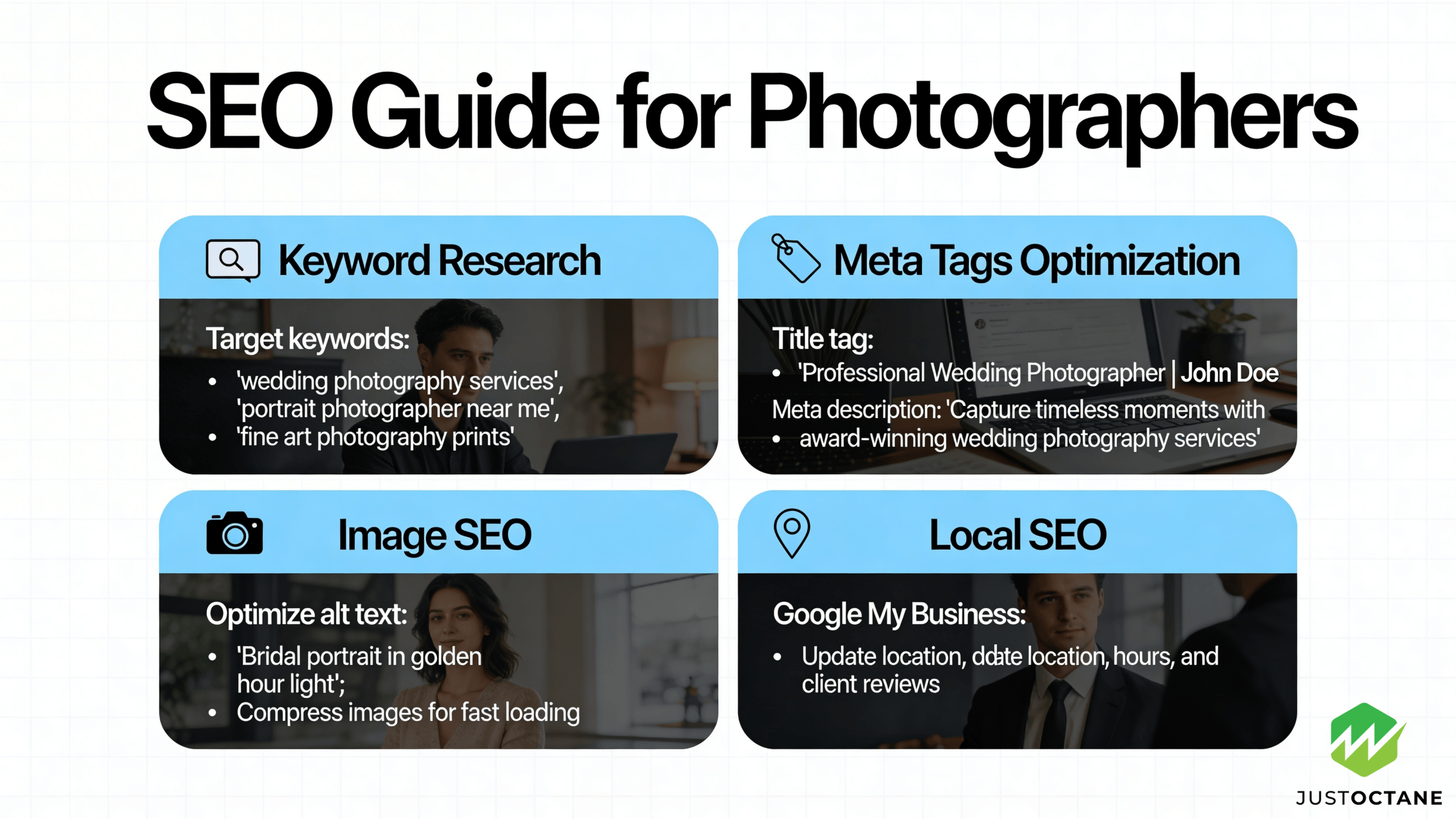
SEO is what turns a nice-looking website into a dependable source of inquiries. In plain terms, SEO helps website owners connect with the people who are most likely to hire them. This guide breaks down the practical, on-page and technical SEO work that helps a photographer show up in Google search results, earn trust, and convert visitors into paying clients. If you want an expert team to implement the strategy (not just talk about it), JustOctane can help you build a sustainable website SEO plan tailored to your market.
Contents
- 1 What SEO means for a photography business (and what search engines look for)
- 2 Keyword research for wedding, family, and newborn services
- 3 Site structure and page mapping (so Google understand your pages)
- 4 Title tag and meta description writing that improves clicks
- 5 Portfolio pages that convert (online portfolio + proof that sells)
- 6 Turn search traffic into booked clients (conversion-focused SEO)
- 7 Image SEO: filenames, file sizes, alt text, and accessibility
- 8 Content and blog posts that keep your site relevant
- 9 Local SEO: Google Business Profile, reviews, and location relevance
- 10 Technical SEO and measurement (the part most competitors skip)
- 11 How JustOctane helps photographers rank (without the guesswork)
- 12 FAQ
- 12.1 How long does it usually take for SEO changes to affect a photographer’s website?
- 12.2 Which on-page elements matter most for photographer websites?
- 12.3 How does image optimization affect page speed (Core Web Vitals) and search rankings?
- 12.4 What structured data (schema) should photographers implement to improve visibility?
- 12.5 How important are backlinks for local photographer SEO?
What SEO means for a photography business (and what search engines look for)
At its core, search engine optimization is the process of making your site easy to crawl, easy to understand, and genuinely useful for people who are searching. In photography, that usually means local intent (“wedding photographer in…”) plus proof (“portfolio”) plus confidence (“pricing, process, reviews”). Search engines like Google test pages against real user behavior, so the goal is not just traffic—it’s better results: more qualified leads and more booked work.
A high-performing photography website is built for the way clients actually search. That includes service keywords, location modifiers, and the questions people ask before they reach out. When your content aligns with clients actually searching for your style, your pages earn stronger relevance signals, and it becomes easier to help Google better understand the topic of each page. It also helps readers better understand content like pricing, locations, and your process.
Keyword research for wedding, family, and newborn services
Start with keyword research that reflects how people talk, not how photographers talk. You want a primary keyword for each core page, plus a small set of supporting keywords that match the intent. For example, separate pages for wedding, family photography, and newborn photographer services make it easier for search engines understand which page to rank—rather than forcing one page to do everything. If you position yourself as a family photographer in a specific city, give that topic its own page instead of burying it in a general gallery.
To find SEO keywords that bring potential clients quickly, review your own inquiries, check your competitors, and verify demand in tools that show monthly search volume and competition. The “best” keyword is usually the one that matches what you offer, in the exact way people type it into Google search.
If you offer maternity newborn family sessions, build a dedicated service page (or a clearly named section) so dream clients finding you can immediately see the work, packages, and next steps.
Site structure and page mapping (so Google understand your pages)
Most photographers struggle because their site structure hides the pages that should rank. A simple site map is often enough: a home page, a portfolio hub, individual portfolio pages for key categories, and separate pages for your photography services. This structure makes it easier to optimize website content and create internal links that keep people moving.
As you’re creating new pages, make sure the navigation is consistent across the website and that internal links point toward revenue-driving pages. Clean internal linking is one of the simplest ways of helping Google understand which pages you want to rank.
Title tag and meta description writing that improves clicks
Your title tag is a major on-page signal, and it’s also what many people see first in the search results. Write titles that clearly describe the page, include the keyword once, and set expectations.
Next, write a meta description that supports the click. As a rule of thumb, aim for around 150 160 characters, highlight the “who/what/where,” and add a reason to choose you (turnaround time, approach, style). Avoid keyword stuffing—clarity usually wins.
Portfolio pages that convert (online portfolio + proof that sells)
Portfolio is not just pretty images—it’s evidence. Strong portfolio pages show variety, consistency, and a clear “next step.” Keep the text short but specific: what the session includes, who it’s for, and what to expect. A clean online portfolio also reduces bounce rate, which can support rankings over time.
To increase conversions, make sure each page answers the questions people have before they contact you: availability, deliverables, location range, and a simple call to action. When the experience is smooth, potential clients move from browsing to inquiry faster, and you get more of the right work.
Turn search traffic into booked clients (conversion-focused SEO)
Ranking is only half the job. A page can rank and still fail if the visitor can’t quickly understand your offer or take the next step. Treat conversion as part of SEO: when people stay, click, and inquire, you send stronger engagement signals back to Google.
Make sure every service page includes (1) a short process overview, (2) a starting price or “collections begin at” range, (3) a simple contact path, and (4) trust elements like testimonials, publication logos, or a behind-the-scenes note. This is especially important for high-intent searches where the visitor is ready to choose a photographer, not just browse.
Image SEO: filenames, file sizes, alt text, and accessibility
Photography sites live and die by performance. Large image file sizes slow the site, which hurts user experience and can drag down results. Resize images, compress them, and use modern formats when your platform supports it. Then make sure each image has descriptive context so it can rank in image search without looking like spam.
Write descriptive alt text for key images, focusing on what’s actually in the photo and why it matters on the page. This supports accessibility for screen readers and gives search engines more context.
Don’t forget the basics: use a clear file name, add alt text where it fits, and treat the alt tag as a helper—not a place to cram keywords. Done well, alt text SEO can support discovery without sacrificing quality.
Content and blog posts that keep your site relevant
If your site only has service pages, you’ll eventually hit a ceiling. Blog posts give you a way to publish helpful content that targets longer-tail searches and builds topical authority. The goal is to write content that answers real questions and supports bookings, not to publish fluff.
Ideas that often perform well include venue guides, “what to wear,” timelines, and session planning. Each new blog post should link back to the most relevant service page and portfolio. Over time, quality blog posts create more entry points from organic search and help search engines understand your overall expertise.
When you write blog posts, aim for clarity, original examples, and a consistent voice. That’s how you earn links, shares on social media, and stronger engagement—all signals that can help rankings.
Local SEO: Google Business Profile, reviews, and location relevance
For many photographers, the fastest wins come from local search. Set up and fully optimize your Google Business Profile (and keep it updated). Add services, upload new photos, and ask happy clients for reviews that mention the type of session (wedding, family, newborn) and the city. This strengthens your google business profiles footprint and supports visibility when people use Google search with local intent.
Connect your listing to your website with consistent name, address, and phone details, and use Google Search Console to confirm which pages are indexed and which queries drive impressions. The combination of a strong business profile and clear service pages is one of the most reliable ways to earn qualified inquiries.
Technical SEO and measurement (the part most competitors skip)
To stand out, go beyond the basics. Add structured data (schema) so Google can interpret your business details, services, and reviews with less guesswork. Photographers can also benefit from image-related markup on key portfolio pages, and from tightening index control so client galleries, proofing pages, or thin duplicates don’t dilute your quality signals.
If you’re doing advanced work, prioritize Core Web Vitals (especially LCP on image-heavy pages), use canonical tags when you republish the same gallery in multiple places, and apply noindex to client proofing galleries so thin pages don’t compete with your main portfolio. Keep your sitemap clean, confirm robots rules aren’t blocking important pages, and validate your markup in Search Console so the data is eligible for rich results.
Next, measure what matters. In addition to Google Search Console, set up analytics events for contact-form submissions and phone clicks. Use UTM parameters on your social media bio link and paid campaigns so you can see which channel and which page produces booked work.
For attribution, connect Google Analytics 4 to your lead events, add call tracking if phone calls matter in your business, and push lead sources into your CRM (even a simple spreadsheet) so you can see which keyword and page actually produced revenue—not just clicks.
Finally, test and iterate. If a page is getting impressions but weak clicks, adjust the title tag and meta description. If it’s getting clicks but not inquiries, improve the copy, the offer, and the call to action. This is the practical loop that tells Google your site deserves to rank—and it’s how you build signals that trust Google over time.
How JustOctane helps photographers rank (without the guesswork)
JustOctane is an SEO company that helps photographers build a strategy that’s measurable, technically sound, and aligned with real client intent. Whether you’re on Squarespace, Showit, or WordPress, we can run an SEO photography website audit, fix technical SEO issues, improve page optimization, and build content that attracts dream clients.
If you want support with keyword mapping, writing, image optimization, and ongoing improvements, reach out to JustOctane for a clear plan and a timeline you can actually follow. You can start with a one-time audit or a monthly plan—either way, the goal is consistent growth in search results and more booked clients.
FAQ
How long does it usually take for SEO changes to affect a photographer’s website?
There is no instant answer, but multiple industry studies and expert guidance show most SEO changes take weeks to months to show measurable ranking and traffic effects. Smaller technical fixes (indexing, meta tags, robots) can be reflected in search results within days–weeks if Google crawls the pages quickly; meaningful gains from content, on-page optimization, and link-building typically appear in about 3–6 months on average, and sometimes 6–12 months for competitive keywords.
Sources: Google’s overview of how search works and indexing, plus industry analyses such as Ahrefs’ “How Long Does It Take to Rank in Google?” and Moz/industry reports on time-to-rank.
Which on-page elements matter most for photographer websites?
Research and official guidance point to a core set of on-page elements with outsized impact:
- Title tag and meta description (clear, keyword-relevant): influences CTR and relevance.
- H1 and semantic headings: organize content and signal topic hierarchy.
- Image alt text and descriptive filenames: crucial for image search and accessibility.
- Page content quality and topical depth (unique galleries, service pages, blog posts): helps satisfy user intent.
- Structured markup where appropriate (schema for local business, images, reviews): improves SERP features.
These recommendations align with Google’s SEO Starter Guide and empirical on-page studies.
How does image optimization affect page speed (Core Web Vitals) and search rankings?
Images are often the largest resource on photographer sites; unoptimized images can worsen Largest Contentful Paint (LCP) and overall page speed, which factor into user experience metrics Google uses (Core Web Vitals). Optimizing images—proper formats (WebP/AVIF where supported), responsive sizes (srcset), compression, and lazy-loading—reduces LCP and improves perceived performance, which can indirectly help rankings and improve conversions.
What structured data (schema) should photographers implement to improve visibility?
Useful schema types for photographers include:
- LocalBusiness or ProfessionalService (for local SEO and contact details).
- ImageObject for images you want Google to understand better (title, caption, copyright, license).
- BreadcrumbList to improve site navigation snippets in SERPs.
- Review and AggregateRating if you display customer reviews (can enable rich snippets).
Implementing relevant structured data helps search engines interpret your content and enables enhanced SERP features (rich results). Always validate with Google’s Rich Results test and follow schema.org/Google documentation.
How important are backlinks for local photographer SEO?
Backlinks remain a primary ranking signal in study after study. For local photography businesses, relevant local citations and backlinks from local publications, partner vendors, wedding blogs, galleries, and directories boost local authority and visibility in both regular and local (Maps) results. Industry surveys and ranking-factor analyses consistently place backlinks among the top ranking factors, alongside on-page relevance and Google My Business signals.
Emphasize quality and topical relevance (local wedding venues, city event sites, photography associations) rather than volume of low-quality links.