

Landscaper SEO: A Practical Local SEO Playbook to Win More Landscaping Leads
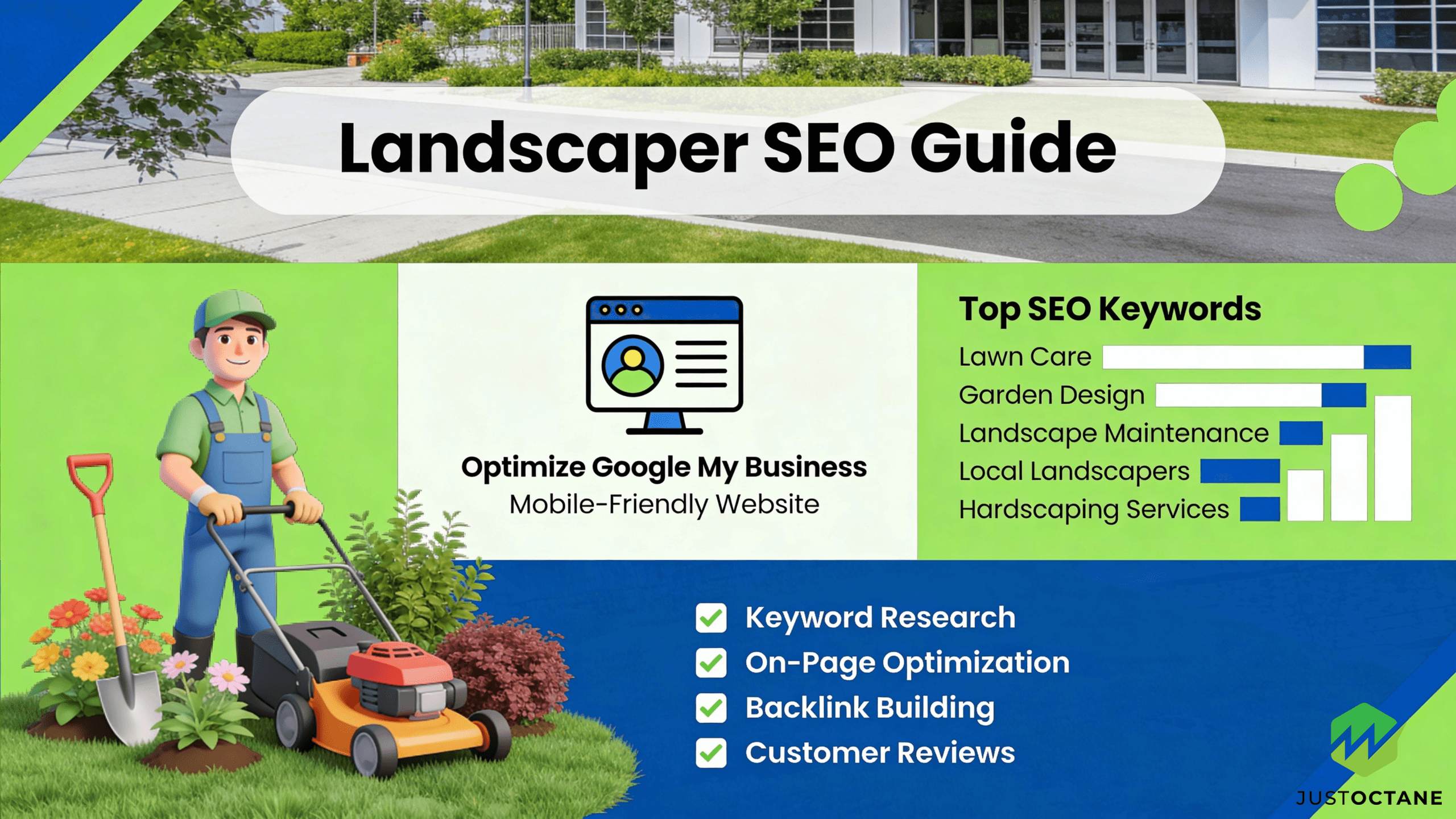
SEO for a landscaping business isn’t about vanity rankings—it’s about showing up in local search results when potential customers need lawn care, landscape design, or seasonal services, and then turning that visibility into booked work.
Contents
- 1 What SEO means for landscapers (and what “good” looks like)
- 2 1) Optimize your Google Business Profile to win Google Maps and the local pack
- 3 2) Build service pages that match search intent (not a generic services page)
- 4 3) Use keyword research to find long tail keywords you can actually win
- 5 4) Technical SEO that protects rankings: speed, crawlability, and mobile friendly UX
- 6 5) Reviews, authority, and the signals that build trust
- 7 6) Measure what matters: leads, conversion rate, and job profitability
- 8 7) Turn local visibility into booked work: lead qualification and fast follow-up
- 9 8) Prepare for AI-driven results (without abandoning the fundamentals)
- 10 How JustOctane helps landscaping companies turn SEO into predictable work
- 11 FAQ
- 11.1 1. How long does SEO typically take to show measurable results?
- 11.2 2. Do Core Web Vitals affect rankings, and how important are they?
- 11.3 3. Which matters more for rankings: backlinks or on‑page factors?
- 11.4 4. What is E-E-A-T and how does it affect search performance?
- 11.5 5. What metrics should I track to measure SEO success?
What SEO means for landscapers (and what “good” looks like)
Search engine optimization (SEO) is the process of improving your website, content, and online presence so search engines like Google can understand your services, trust your company, and surface your pages in search engine results. In the landscaping industry, “good” SEO usually looks like:
1) consistent leads from your service area, 2) steady organic traffic to high-intent service pages, and 3) long term growth that doesn’t disappear when you pause ads.
To align with Google’s own guidance, start with the “Search Engine Optimization (SEO) Starter Guide” (Google Search Central, Google for Developers).
1) Optimize your Google Business Profile to win Google Maps and the local pack
For SEO landscapers, your Google Business Profile is often the fastest path to better local search rankings. When someone searches “landscaping company near me,” Google Maps listings and the map pack can capture the click before they ever reach your website.
Focus on the basics of a strong business profile: pick the right categories, add services, upload real job photos, and keep your address phone number and hours consistent across your site and listings. This is the core of optimizing Google Business for both local search results and click-throughs.
Pro tip: treat your profile like a conversion page. Add clear calls to action, a quote request workflow, and messaging that matches what local customers want (response time, warranty, licensing, and cleanup standards).
2) Build service pages that match search intent (not a generic services page)
Landscaping SEO works best when each core offering has a dedicated page. Instead of forcing everything onto one create focused service pages for landscaping services such as lawn care services, landscape design, irrigation, drainage, snow removal, and hardscape projects. This structure helps your page SEO and improves results because each page can target relevant keywords.
For multi-city visibility, build location-aware content without creating thin, repetitive pages. A strong approach is to pair a landscaping company page (your main service hub) with service area content that explains where you work, what’s different by city, and shows proof (projects, reviews, and crews).
3) Use keyword research to find long tail keywords you can actually win
Keyword research should map directly to revenue. Start by listing your money services, then expand into “near me” and problem-based searches (grading, drainage fixes, sod replacement, patio pavers, retaining walls). Tools like Google Keyword Planner can help you estimate search demand, but always sanity-check terms against what your clients actually ask for.
Next, publish content that supports your service pages: project spotlights, pricing/estimate explainers, and seasonal guides (spring cleanup, fall leaf removal, winter snow removal). Consistent content creation is one of the most reliable ways to increase organic traffic over time.
4) Technical SEO that protects rankings: speed, crawlability, and mobile friendly UX
Technical SEO is where many landscaping company websites quietly lose leads. Your site should load fast, be secure, and be easy for search engines to crawl. Make sure every important page is linked from your navigation and that your site structure supports your strategy.
Since most landscaping searches happen on a phone, prioritize a mobile friendly site and a mobile friendly website experience: click-to-call buttons, fast forms, and readable service summaries. Use Google PageSpeed Insights to identify what’s slowing your website down, and fix issues that hurt google search results on mobile.
In competitive local SEO, reviews can be the difference between “we show up” and “we get the call.” Build a repeatable review request process after every completed job, respond to feedback, and highlight reviews on relevant pages.
Beyond reviews, earn authority with local relationships: suppliers, nurseries, HOA partners, real estate agents, chambers of commerce, and community sponsorships. Pair that with a simple social media system that repurposes before/after photos into posts, and you’ll reinforce your brand while helping your company rank higher.
6) Measure what matters: leads, conversion rate, and job profitability
Rankings are a lagging indicator. To understand whether SEO services are working, track leads (calls, forms, and quote requests), your conversion rate from website traffic, and what percentage of those leads turn into profitable jobs.
Use tools like Google Search Console for query data, then compare it to what you see in local search results and on your own sales reports. Pair this with call tracking and CRM attribution so you can see which pages produce high-quality potential customers.
7) Turn local visibility into booked work: lead qualification and fast follow-up
SEO and content can generate traffic, but your sales process decides whether you win the job. Tighten your quote request flow so you only attract the right potential customers: ask for the service type, property size, zip code, and photos (especially for drainage, grading, or hardscape work). Set expectations for response time and minimum job size so your clients aren’t guessing.
If you use call tracking with dynamic number insertion, do it carefully so your address phone number remains consistent for local SEO. This is where many companies accidentally create NAP inconsistencies that can hurt rankings.
Finally, connect marketing to operations: route planning for crews, capacity planning during peak season, and a simple handoff checklist that ensures every lead gets a same-day callback.
8) Prepare for AI-driven results (without abandoning the fundamentals)
Search is changing fast. Between Google AI Overviews and other AI-powered experiences, you want content that is clear, factual, and easy to summarize. This is where generative engine optimization overlaps with classic SEO: use helpful headings, answer common questions, and support claims with proof (photos, credentials, and reviews).
And yes—the fundamentals still matter.
How JustOctane helps landscaping companies turn SEO into predictable work
Most landscapers don’t need more marketing noise—they need a clear SEO strategy that connects local search visibility to booked estimates. JustOctane is an SEO and digital marketing partner that builds the foundation (technical fixes, content, and Google Business work) and then iterates based on real results.
If you want an honest benchmark of your current website, rankings, and local SEO gaps, talk to JustOctane about a landscaping SEO plan tailored to your service area and the services you want to sell most.
FAQ
1. How long does SEO typically take to show measurable results?
Research and industry studies consistently show that SEO is a medium-to-long-term channel. In most cases you can expect to see measurable changes in organic traffic or rankings within about 3–6 months, with more substantial gains often taking 6–12+ months. Time-to-results depends on factors such as domain authority, competition for target keywords, content quality, backlink acquisition rate, and technical health of the site.
See practical analyses from practitioners: Ahrefs and Moz review multiple sites and report typical windows of several months before consistent ranking changes become visible. Google also emphasizes that relevance and authority build over time rather than overnight.
2. Do Core Web Vitals affect rankings, and how important are they?
Core Web Vitals (Largest Contentful Paint, First Input Delay/Interaction to Next Paint, and Cumulative Layout Shift) are part of Google’s Page Experience signals and are used as ranking signals. However, Google and empirical analyses say they are a ranking factor among many — important for user experience but not a substitute for relevance and content quality. Improving Core Web Vitals can reduce user frustration and indirectly help SEO via better engagement and lower bounce rates.
3. Which matters more for rankings: backlinks or on‑page factors?
Both are essential. Large-scale correlation studies (Ahrefs, Backlinko) show backlinks remain one of the strongest correlates of higher rankings, but Google consistently states that relevance, content quality, and other on‑page & technical signals also matter. Practically, sites with strong content and good on‑page optimization but few quality backlinks will usually struggle to outrank authoritative sites that combine both. The best strategy is a balanced one: create high-quality, relevant content, optimize technical/on‑page factors, and earn authoritative backlinks.
4. What is E-E-A-T and how does it affect search performance?
E-E-A-T stands for Experience, Expertise, Authoritativeness, and Trustworthiness. It originates from Google’s Search Quality Rater Guidelines as attributes human raters use to evaluate content quality. While raters don’t directly set rankings, the guidelines inform algorithm development, so signals related to E-E-A-T (author credentials, site reputation, trustworthy sourcing, demonstrated first‑hand experience) can influence how well content is assessed and surfaced by Google—especially for YMYL (Your Money or Your Life) topics.
5. What metrics should I track to measure SEO success?
Track a mix of performance, visibility, and business-impact metrics:
- Visibility & acquisition: organic impressions, clicks, click‑through rate (CTR), and organic sessions (Google Search Console + GA4).
- Rankings: positions for priority keywords and how they change over time (use robust rank-tracking tools).
- Engagement: pages per session, average session duration, bounce/engaged‑session rate, and Core Web Vitals.
- Conversion & business impact: goal completions, leads, sales, revenue attributed to organic traffic.
- Authority signals: referring domains and quality of backlinks (quality > quantity).
Use Google Search Console and Google Analytics (GA4) for primary reporting, and supplement with crawl/technical tools and backlink/keyword tools for depth.