

Mobile seo services and website optimization for google search rankings
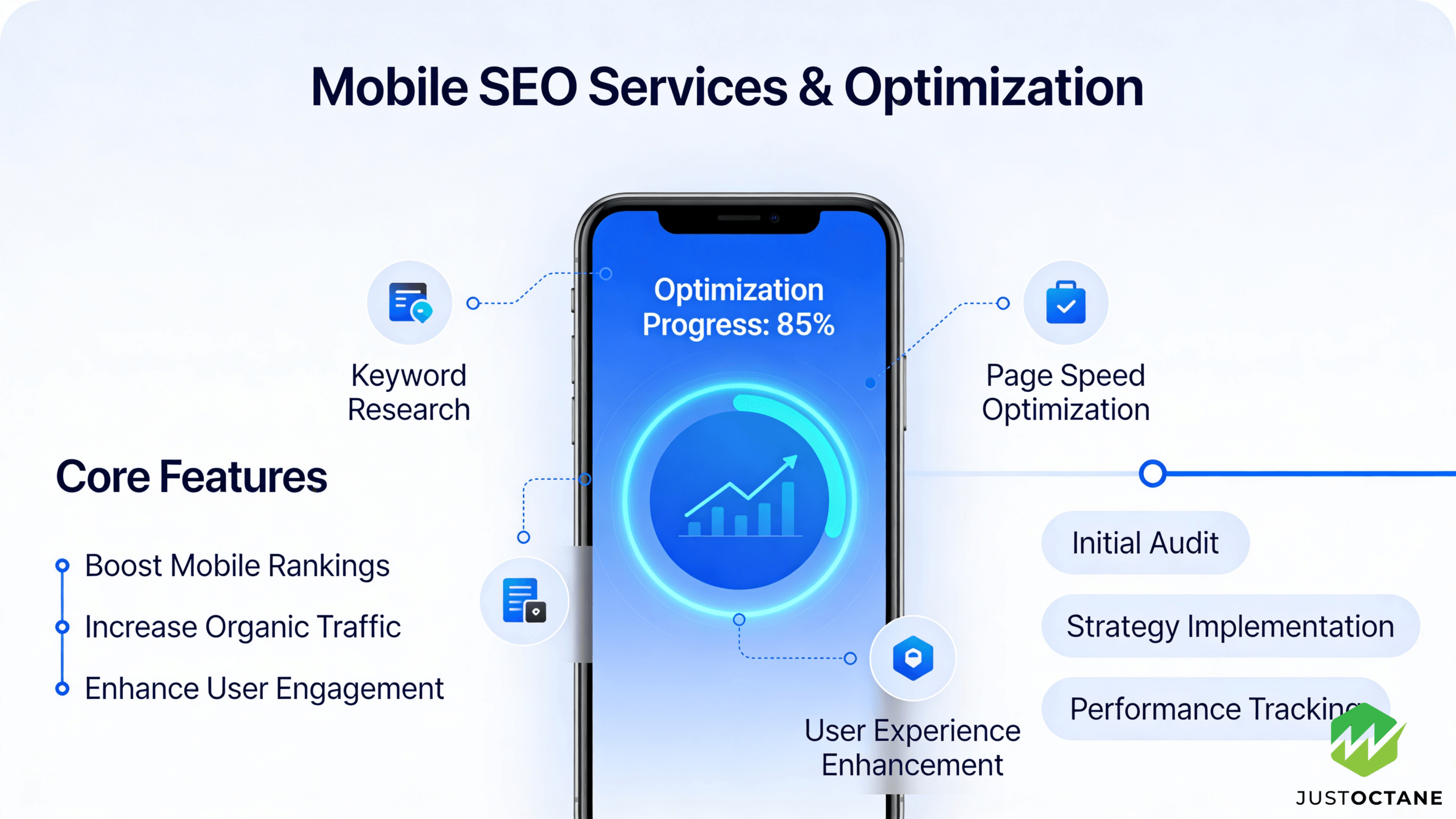
Mobile SEO services help a website win more search visibility by improving the mobile experience, technical performance, and content relevance that search engines evaluate first. In practice, this means building pages that load fast, look great on small screens, and convert mobile users into leads and customers for your business, turning each visit into a qualified lead.
Contents
- 1 What mobile SEO services should include (deliverables that matter)
- 2 Mobile-first indexing: make the mobile version the source of truth
- 3 Responsive web design and mobile user experience: the UX layer that drives rankings
- 4 Page speed, mobile performance, and Core Web Vitals (why slow loading pages lose revenue)
- 5 Technical SEO for mobile: fix indexing, crawling, and structured data issues first
- 6 Content, local SEO, and voice: optimize for how people actually search on phones
- 7 Measurement and iteration: turn data into repeatable growth
- 8 How JustOctane helps (a practical mobile SEO solutions partner)
- 9 FAQ
- 9.1 1. How do Core Web Vitals (page speed and UX metrics) affect search rankings?
- 9.2 2. How does E‑A‑T (Expertise, Authoritativeness, Trustworthiness) influence rankings?
- 9.3 3. Are backlinks still an important ranking signal?
- 9.4 4. Does structured data/schema markup improve rankings or visibility?
- 9.5 5. What is mobile‑first indexing and what does it mean for SEO?
What mobile SEO services should include (deliverables that matter)
The strongest mobile SEO services combine strategy, implementation, and reporting. A good mobile SEO agency will align web design, technical SEO, and digital marketing so your site can earn better search engine rankings, not just “pass a test.” For businesses, the goal is simple: more qualified organic traffic and measurable results.
Typical deliverables include a mobile SEO audit, mobile SEO optimization roadmap, content updates, and fixes that keep mobile site quality high across devices. When you work with an experienced SEO services team, you should also see documentation your internal team can use, like QA notes, priority tickets, and before/after benchmarks.
Mobile-first indexing: make the mobile version the source of truth
Because Googles mobile indexing uses the mobile version of a page for indexing and ranking, any mismatch can cap engine rankings. To improve mobile SEO, ensure website parity: the same primary content, headings, internal links, and structured data should exist on desktop and on the mobile site.
Start with Google’s guidance here: “Mobile-first Indexing Best Practices”. Then validate your title tags meta descriptions, canonicals, and robots directives for every important page.
Responsive web design and mobile user experience: the UX layer that drives rankings
Responsive web design keeps one URL and one content set, which reduces technical risk and improves long term maintenance. It also strengthens user experience signals because layouts fit the screen size, tap targets are comfortable, and key actions are easy to complete.
Great mobile user experience is not cosmetic. Mobile friendly navigation, readable typography, and clear CTAs help reduce bounce rates from the search results. Avoid intrusive pop ups that block content or make the page hard to use; they frustrate visitors and can weaken performance in mobile search.
In design development reviews, look for friction points on real phones and tablets (not only desktop emulators), especially on forms, menus, and any step where users might hesitate.
Page speed, mobile performance, and Core Web Vitals (why slow loading pages lose revenue)
Speed is one of the fastest ways to improve conversions on mobile devices. When mobile page speed is poor, users abandon sessions quickly, and that loss compounds into lower traffic over time.
Use this benchmark as context: “The need for mobile speed.” Then build an optimization plan around Core Web Vitals (LCP, CLS, and INP), image compression, caching, and modern formats. These steps improve mobile site performance and create a smoother mobile experience for optimized mobile users.
One practical “gap” many sites miss: combine lab tests (Lighthouse) with field data (Chrome UX Report) to see what real mobile users experience on real networks.
Technical SEO for mobile: fix indexing, crawling, and structured data issues first
Technical SEO is where mobile indexing problems hide—especially on JavaScript-heavy websites. A technical mobile SEO review should confirm search engines can fetch critical resources, render content, and understand your structured data.
- Check crawl paths, redirects, and broken links so the search engine reaches key pages efficiently.
- Confirm canonical tags and the mobile version are consistent (no accidental noindex).
- Validate structured data, title tags meta descriptions, and pagination where applicable.
- Use google search console to review coverage, enhancements, and mobile usability reports.
- Re-test after releases to ensure mobile performance does not regress.
For larger sites, add a log review: compare server logs against google search console to see how Googlebot Smartphone crawls your mobile version, which templates waste crawl resources, and where rendering breaks on specific devices.
These fixes support search engine optimization at the foundation, so content and link building efforts are not wasted. If you need an SEO mobile checklist for developers, start with crawlability, rendering, and speed.
Content, local SEO, and voice: optimize for how people actually search on phones
Content still wins, but mobile content needs tighter formatting and clearer intent matching. Start with keyword research for mobile search, then create pages for optimized mobile search and paid landing pages that answer the user quickly and guide them to the next step. This is also where location based intent matters: local SEO pages, consistent NAP details, and fast maps/directions experiences can boost online visibility.
As part of an SEO strategy, use voice search patterns (“near me,” “best,” and question phrasing). Even simple improvements—like concise headings, relevant FAQs, and better internal linking—help the site earn more prominent search results for your target audience.
For multi-location brands, publish unique local content instead of cloning templates, and keep each page optimized mobile without stripping context that helps users make a decision.
Measurement and iteration: turn data into repeatable growth
Mobile optimization is a process, not a one-time project. Track organic traffic, conversion rates, and engagement (including bounce rates) in google analytics, then cross-check with google search console to see which queries and pages drive results. Review search rankings and engine rankings by device class, because mobile users can behave differently than desktop users.
A data driven workflow makes it easier to explain performance to stakeholders and helps ensure the right priorities stay in your roadmap—especially when teams ship updates that affect scripts, images, and page templates.
How JustOctane helps (a practical mobile SEO solutions partner)
If you want a partner who can execute, JustOctane is a mobile SEO company that blends SEO best practices with hands-on implementation. We start with a mobile SEO audit to identify technical SEO blockers, then deliver a prioritized plan (impact vs effort) for mobile SEO services that improves page speed, content quality, and mobile site reliability.
Whether you need a full SEO agency engagement or targeted seo optimization support, our approach is built to help clients increase visibility, capture more leads, and keep performance strong across search engines. To discuss your website, request a scoped plan from the JustOctane team.
FAQ
1. How do Core Web Vitals (page speed and UX metrics) affect search rankings?
Google uses Core Web Vitals (field metrics such as Largest Contentful Paint, Cumulative Layout Shift, and an interaction metric) as part of its page experience signals. These metrics help Google assess real-world user experience; when other relevance signals are similar, better Core Web Vitals can act as a tiebreaker. Improving these metrics also reduces user frustration and bounce rates, which is shown in lab and field studies to increase engagement and conversions even when ranking impact is modest.
2. How does E‑A‑T (Expertise, Authoritativeness, Trustworthiness) influence rankings?
E‑A‑T is a framework Google uses in its human search quality evaluations to judge content quality—especially important for YMYL (Your Money or Your Life) pages. While E‑A‑T itself is not a single algorithmic signal, the attributes it describes (author credentials, site reputation, accurate citations, secure handling of user data) map to measurable signals that Google’s systems can use. Research and Google’s evaluator guidelines show improving E‑A‑T-related factors reduces the chance content is downgraded for quality.
3. Are backlinks still an important ranking signal?
Yes. Links remain a foundational signal because they carry topical and reputational information (the original concept behind PageRank). High-quality, relevant backlinks are consistently correlated with stronger organic performance in industry studies and are explicitly referenced in Google’s documentation as a ranking factor; manipulative link schemes, however, are penalized. The focus today is on earning authoritative, relevant links rather than quantity alone.
4. Does structured data/schema markup improve rankings or visibility?
Structured data (schema) does not guarantee a rankings boost by itself, but it helps search engines understand page content and enables eligibility for rich results (rich snippets, knowledge cards, etc.). Multiple studies and Google guidance show that rich results often increase click-through rates (CTR), which improves organic traffic even if the underlying ranking position doesn’t change.
5. What is mobile‑first indexing and what does it mean for SEO?
Mobile‑first indexing means Google predominantly uses the mobile version of a site’s content, structured data, and metadata for indexing and ranking. If your mobile pages have less content or missing meta/structured data compared with the desktop version, your visibility can suffer. Research and Google guidance therefore recommend responsive design or ensuring parity between mobile and desktop content, metadata, and structured data.