

This is why seo is a must for personal injury lawyers
Personal injury is a high-stakes, high-competition practice area. The firms that win in Google usually do two things at the same time: they become the most relevant answer for specific accident and injury searches, and they look like the safest choice to contact. This guide explains how to improve visibility with search engine optimization (SEO), local SEO, and digital marketing fundamentals—without relying on ads as your only source of leads.
Contents
- 1 Case Study
- 2 1) Why SEO works for personal injury (and what you’re really competing against)
- 3 2) How Google evaluates personal injury (PI) law firm websites: relevance, prominence, and trust
- 4 3) Local SEO foundations: Google Business Profile, the map pack, and NAP consistency
- 5 4) Protect your Google Business Profile (and avoid easy-to-miss suspension triggers)
- 6 5) Keyword research that maps to real case types (not just “personal injury lawyer”)
- 7 6) Site architecture, web design, and on-page SEO that support rankings
- 8 7) Technical SEO: Core Web Vitals, mobile experience, accessibility, and clean indexation
- 9 8) Structured data and schema markup (including JSON-LD) that help when done correctly
- 10 9) Content marketing that builds trust: answer real questions, show your process, stay current
- 11 10) Reviews and reputation: build a system, not a one-time push
- 12 11) Off-page SEO: backlinks, link building, citations, and digital PR that look real
- 13 12) Conversion rate optimization and intake: turning SEO traffic into signed cases
- 14 13) Measurement and timelines: what to track (and what “good” looks like)
- 15 14) Preparing for AI-driven search results (and why clarity is the new advantage)
- 16 15) A simple 30-day SEO plan (start with an SEO audit)
Case Study
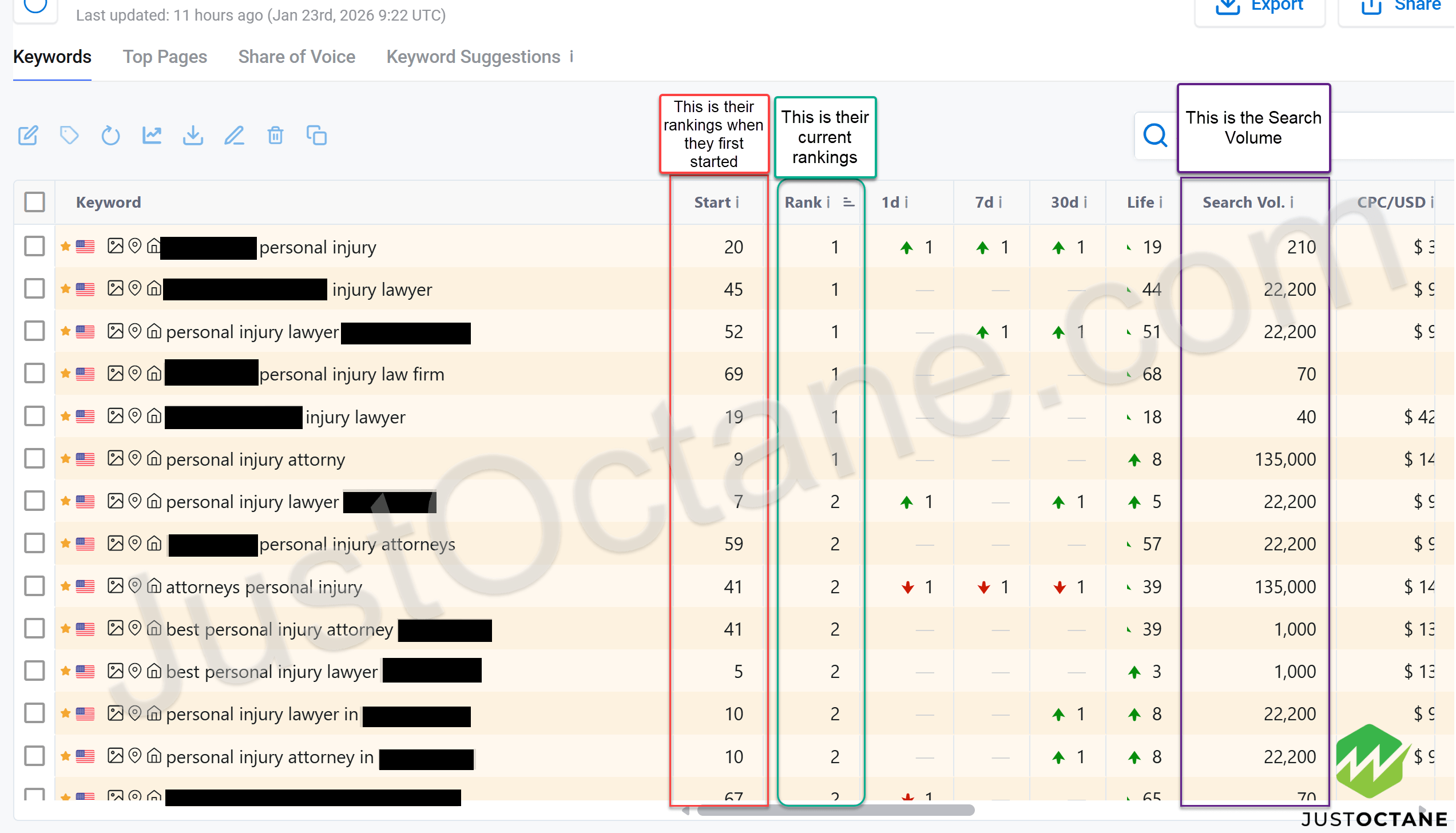
At JustOctane we work with several Personal Injury Lawyers who own law firms that need a consistent flow of leads and so they reach out to us. Here is one of our latest success stories. Below is a screenshot of the rankings we got for a client in one of the most difficult cities to rank in when it comes to personal injury-related keywords.
Out of respect & privacy for our client, we won’t be revealing the city or the name of the client’s practice.
The red outline you see in the image is their rankings when they started with us, and the green outline is their current rankings as of today. The purple outline shows how many people search every month for the specific keyword.
When they started with us they had virtually no traffic or leads coming to their website. Most of the leads they were getting prior to hiring us was from word of mouth. Not only that, but their website needed a complete overhaul, which we were able to do for them.
Getting the leads is one thing, but converting them is another, which is why we had to modify their site so that it converts well once the traffic starts coming in.
So What Was The End Result?
Consistent leads coming through daily:
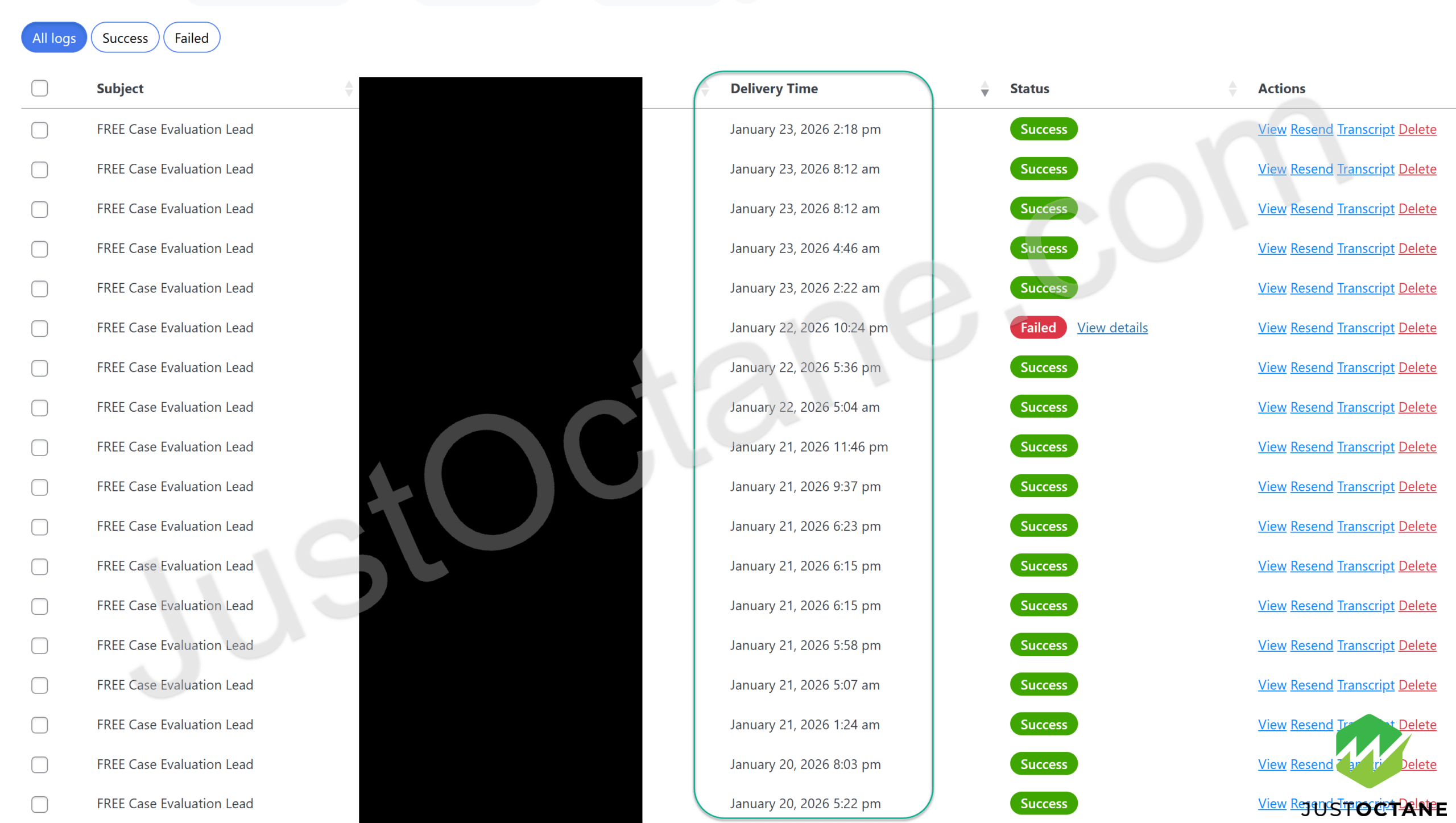
Important: The leads you see in the screenshot above are only from people who filled out the form to get a free case evaluation. This doesn’t account for the people who called, text or interacted with live chat.
If you want us to do the same for your practice, you can contact us here:
1) Why SEO works for personal injury (and what you’re really competing against)
When someone searches “car accident lawyer near me” or “personal injury attorney in Miami,” the intent is usually urgent. They want help now, and they’re comparing options fast. That’s why personal injury lawyer SEO is less about “more traffic” and more about matching the right intent, in the right location, with the right trust signals.
In most markets, you’re competing across three result types: the map pack (local results), the organic listings, and paid placements (PPC/Google Ads and, in some areas, Local Services Ads). A strong law firm SEO strategy treats these as connected, because the same brand signals (reputation, relevance, content quality) tend to reinforce performance across channels.
2) How Google evaluates personal injury (PI) law firm websites: relevance, prominence, and trust
Google rewards pages that clearly answer the searcher’s question, come from a business that appears legitimate, and deliver a good page experience. For legal topics, accuracy and transparency matter because the content can influence high-stakes decisions.
In practical terms, your site should show who is responsible for the content (attorney bios and clear ownership), what you do (specific practice areas), where you do it (real locations and service area clarity), and why you can be trusted (reviews, case experience, third‑party mentions, and consistent business information).
3) Local SEO foundations: Google Business Profile, the map pack, and NAP consistency
If you want to rank in the map pack on Google Maps, your Google Business Profile is non‑negotiable. It’s also where many potential clients decide whether to call—often before they ever visit your website.
The goal is simple: make it easy for Google (and people) to confirm that your firm is real, local, and active. Start with NAP consistency (name, address, phone number) across your website, your Google Business Profile, and your citations in reputable directories.
- Choose the closest primary category available, then add specific services you actually handle (car accidents, truck accidents, slip and fall, wrongful death, medical malpractice if applicable).
- Add real office/team photos and publish occasional updates or posts that match real client needs (e.g., “what to do after a crash”).
- Make sure your main location page mirrors your profile details, including the same phone number and consistent address formatting.
For citations and legal directories, prioritize accuracy over volume. Profiles on platforms like Avvo, Justia, and Yelp can reinforce legitimacy when they are complete and consistent.
If you have multiple offices, treat each as its own real-world entity: one profile per staffed location, one dedicated location page per office, and clean internal linking between offices and the practice pages they serve. Avoid creating extra listings for meeting rooms or unstaffed addresses.
4) Protect your Google Business Profile (and avoid easy-to-miss suspension triggers)
Many firms focus on “optimizing” their profile and forget the bigger risk: losing it. Google can suspend listings that look misleading, even when the intent wasn’t malicious.
Use a real, staffed office address (not a virtual office or mailbox), keep one listing per legitimate location, avoid keyword-stuffing the business name, and make sure your website and citations match your profile exactly. If you move offices or change phone systems, update every major citation source—not just the profile—so you don’t create conflicting signals.
Be cautious with reviews, too: don’t incentivize them and don’t “filter” who gets asked. A steady, compliant review process is safer than a one‑time review push that looks unnatural.
5) Keyword research that maps to real case types (not just “personal injury lawyer”)
Effective keyword research starts with how people describe their situation, not how lawyers describe the practice. Build keyword clusters around (a) accident type, (b) injury, (c) location, and (d) stage of the case.
Examples of high-intent clusters include car accident lawyer, motorcycle accident attorney, truck accidents, slip and fall, pedestrian accident, and wrongful death. You’ll also see valuable “cost and process” queries such as “how much does a personal injury lawyer cost,” “contingency fee,” and “how long do I have to file a claim” (deadlines vary by state, so write these pages carefully and keep them current).
Instead of forcing every keyword onto one page, assign one primary intent per page. This keeps the site organized for users and avoids thin, confusing content that struggles to rank.
6) Site architecture, web design, and on-page SEO that support rankings
On-page SEO is where you turn keyword research into pages that rank and convert. For most firms, the safest structure is a set of focused practice-area pages (accident types and injury categories), supported by a smaller set of location pages that prove you can serve that community.
Avoid creating dozens of near-duplicate city pages that only swap the location name. If you serve multiple areas, each location page should include something real: attorneys who work there, landmarks or courts you genuinely serve, locally relevant FAQs, and clear directions and contact options.
On the page itself, keep it straightforward: a clear title tag, a descriptive H1, scannable H2s, and internal links that help users navigate to the next best step (related case types, resources, and the contact page).
7) Technical SEO: Core Web Vitals, mobile experience, accessibility, and clean indexation
Technical SEO is rarely the reason a great firm can’t rank—but it’s often the reason a good injury law firm can’t break through. Personal injury search traffic is heavily mobile, and a slow or unstable site can hurt both rankings and conversion rate.
Prioritize Core Web Vitals (especially load speed and interaction responsiveness), compress images, remove unnecessary scripts, and make your call-to-action usable with one hand on a phone. Then confirm the basics: HTTPS, crawlable navigation, an XML sitemap, correct canonicals, and no accidental “noindex” tags on key pages.
Don’t ignore accessibility. Clean heading structure, readable contrast, descriptive alt text, and properly labeled form fields help real users and often reduce bounce rates. If you’re working toward WCAG standards, treat it as both risk reduction and a conversion improvement project.
8) Structured data and schema markup (including JSON-LD) that help when done correctly
Schema markup (structured data, commonly added via JSON-LD) doesn’t automatically boost rankings, but it can help search engines interpret your site more accurately. For law firms, the most practical uses are clarifying your organization details and your page structure.
Consider implementing LegalService or LocalBusiness schema for the firm, Attorney schema for key lawyers, BreadcrumbList for navigation, and FAQPage schema for genuine FAQs. Don’t mark up content you don’t visibly show on the page, and don’t add Review markup unless it follows Google’s rules.
If your firm is established, you can also strengthen “entity” consistency by linking official profiles (social accounts and major directory listings) via sameAs references in your structured data.
9) Content marketing that builds trust: answer real questions, show your process, stay current
Great personal injury content reduces uncertainty. It explains what happens next, what varies by case, and what a client should do today. This is also where you can differentiate from competitors that publish generic pages.
Beyond practice pages, publish blog posts and resources your intake team actually wishes every caller had read first: what to document at the scene, when to seek medical care, how insurance statements can be used, what “liability” means in plain language, and what evidence helps prove damages.
Two content opportunities many firms overlook are fee and deadline education and the client experience itself. A well-maintained page on contingency fees and a state-specific page on filing deadlines can attract anxious, high-intent searchers—so long as you keep the information updated and clearly state it’s general information, not legal advice. Separately, outline what happens after someone contacts you (conflicts check, investigation, medical record collection, negotiation, and litigation if needed). People don’t only hire the highest-ranking site; they hire the firm that feels organized.
If you serve multilingual communities, consider publishing key pages in Spanish (or other languages your staff can support). Avoid auto-translation. A well-written bilingual experience can win cases in markets where competitors only publish English pages, and it can reduce friction for clients who are already under stress.
Finally, keep marketing compliance in mind. State bar advertising rules vary, but in general you’ll want to avoid misleading comparisons (“best”), guarantees, and cherry-picked outcomes without context. When in doubt, add clear disclaimers and have an attorney review content before it goes live.
10) Reviews and reputation: build a system, not a one-time push
In personal injury SEO, reviews influence both map visibility and human decisions. The goal isn’t just more reviews; it’s a consistent pattern of credible feedback over time.
Create a simple process: ask at the right moment (often after a meaningful milestone), make it easy with one link, and respond professionally. When you respond, avoid discussing sensitive case details; focus on empathy, professionalism, and next steps.
11) Off-page SEO: backlinks, link building, citations, and digital PR that look real
Backlinks are still a major competitive separator in saturated PI markets. The safest approach is to earn links the way legitimate businesses do: community involvement, local sponsorships, bar association participation, local news commentary, and partnerships with organizations you genuinely support.
When you pursue link building, prioritize relevance and editorial context. A single strong local news mention can be more valuable than dozens of low-quality directory links. At the same time, maintain your core local citations so Google sees consistent business data across the ecosystem.
12) Conversion rate optimization and intake: turning SEO traffic into signed cases
Traffic is not the goal—signed cases are. That’s why conversion rate optimization (CRO) matters in personal injury SEO. Small changes like clearer navigation, shorter forms, and stronger click-to-call buttons can increase qualified leads without changing rankings.
If you use live chat, make sure it routes to trained staff or an answering service that understands your screening criteria. A chat tool that collects low-quality leads can create a reporting “win” while reducing real case value.
Call tracking is useful, but it has a local SEO downside if implemented incorrectly. Avoid publishing multiple phone numbers across the web. Use dynamic number insertion on your website, keep one primary number as the canonical NAP, and keep your Google Business Profile and major citations consistent.
Also think about privacy and call compliance. If you record calls, confirm consent rules in your state and ensure your website privacy policy reflects your tracking tools.
Finally, treat speed-to-lead as part of SEO. Many firms lose cases because they respond too slowly. If you can’t staff phones 24/7, build a reliable after-hours workflow and set expectations clearly on the site.
13) Measurement and timelines: what to track (and what “good” looks like)
Rankings are a leading indicator, not the outcome. Track organic calls, form leads, consultation rate, signed-case rate, and (where possible) cost per signed case. Google Search Console and GA4 can show demand and page performance, while your CRM/intake system shows which leads turned into real revenue.
Set expectations on timing and reporting. In competitive markets, meaningful organic movement often takes months, not days, and a monthly review cadence is usually enough to spot trend lines without overreacting to normal fluctuations.
If you’re considering personal injury lawyer SEO services from an SEO agency or SEO company, ask how they handle NAP consistency, attorney review workflows, link building standards, and reporting tied to signed cases—not just traffic.
14) Preparing for AI-driven search results (and why clarity is the new advantage)
Search results are increasingly influenced by AI summaries and answer-first experiences. The firms most likely to benefit tend to publish content that is easy to extract and cite: concise answers under descriptive headings, followed by detail that demonstrates real experience.
If you want your pages to be treated as a trusted reference, focus on credibility signals: attribute content to real attorneys, keep pages updated, cite primary sources when appropriate (court rules, government safety resources, official insurance documents), and answer the question early before expanding into nuance.
15) A simple 30-day SEO plan (start with an SEO audit)
If you need a practical starting point, use this sequence:
- Week 1: audit your Google Business Profile, fix NAP inconsistencies, and clean up the top citations that control the rest.
- Week 2: map keywords to pages (one primary intent per page) and rewrite titles/H1s for your highest-value practice pages.
- Week 3: improve mobile speed and Core Web Vitals on your top landing pages; tighten contact paths (click-to-call, short forms, chat).
- Week 4: publish one resource page (what to do after a crash) and one trust page (fees/deadlines/process), then start a sustainable review workflow.
From there, expand into link earning and content clusters. Consistency beats intensity: steady improvements compound, while shortcuts often create penalties, suspensions, or wasted spend.
SEO should also work alongside paid search (SEM) when it makes sense: use ads for short-term coverage while organic rankings build long-term stability.
Bottom line: the best personal injury lawyer SEO strategy makes it effortless for a stressed, injured person to find you, trust you, and contact you—whether they see you in the map pack, the organic results, or both.