

15 Website traffic strategies that compound (seo, content, social, email, and paid)
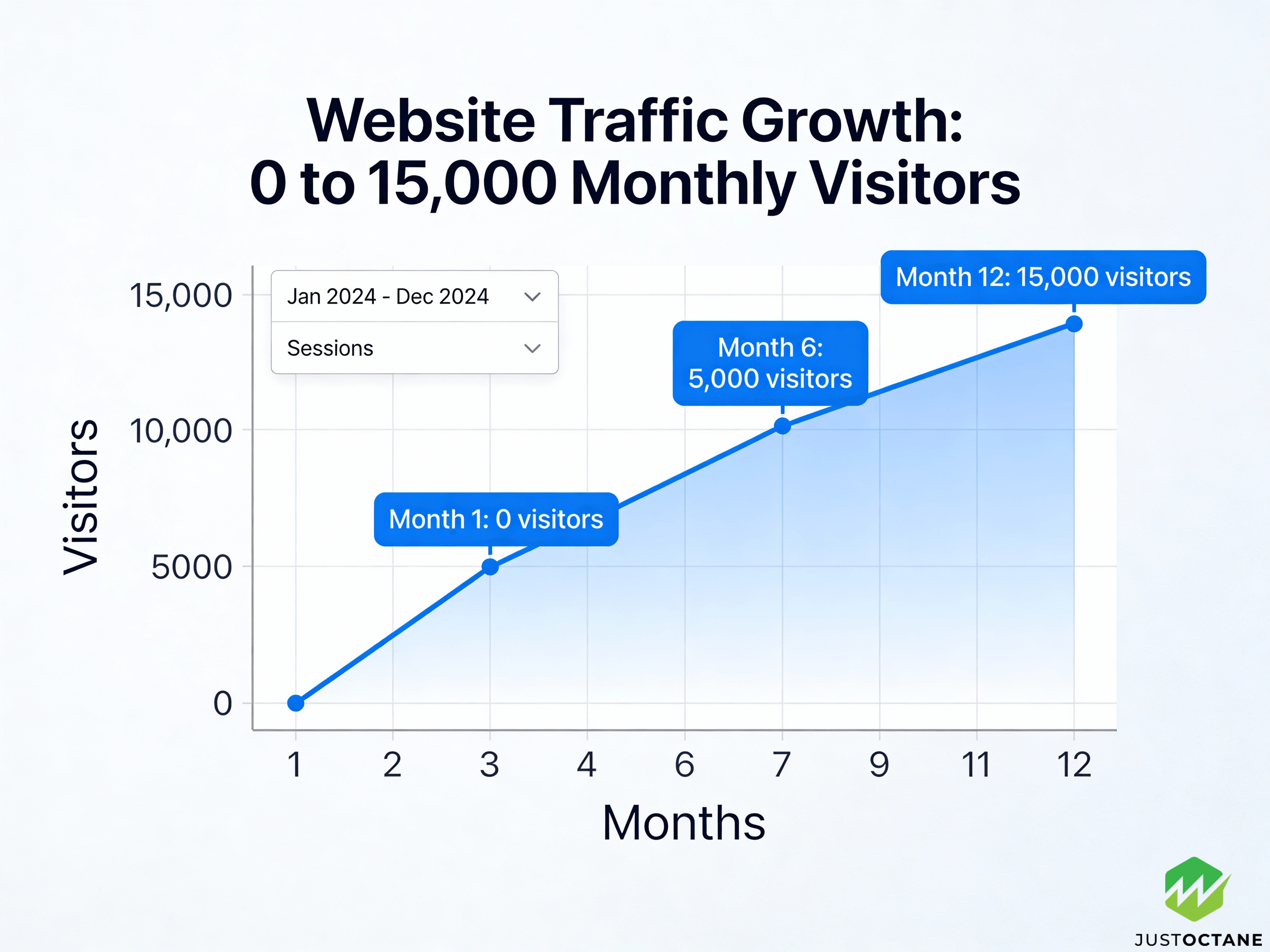
More website traffic is useful only when it attracts the right visitors: people who match your offer and take meaningful actions. The goal is to (1) get discovered in search engines and social feeds, (2) earn the click in the SERPs, and (3) turn first-time visitors into returning visitors.
The strategies below are ordered from foundation to acceleration, so you can improve organic search, referral traffic, and paid acquisition without chasing vanity metrics.
Before getting into the strategies, I would like to say the following:
Contents
- 1 Hire An SEO Company Like JustOctane For Best Results
- 2 1) Set a baseline in Google Analytics 4 (GA4) or Matomo—then measure quality
- 3 2) Use Google Search Console to find quick organic wins
- 4 3) Do keyword research around intent (and prioritize long-tail keywords first)
- 5 4) Build topical authority with a simple topic cluster (pillar page + supporting articles)
- 6 5) Improve internal linking and navigation so the site is user-friendly
- 7 6) Write title tags that earn the click in the SERPs
- 8 7) Use meta descriptions as ad copy (even if Google rewrites them)
- 9 8) Upgrade page experience: mobile-friendly design, speed, and Core Web Vitals
- 10 9) Create content that’s deep enough to be cited (not just “written”)
- 11 10) Use images, video, and YouTube to capture additional searches
- 12 11) Fix technical SEO so crawlers can discover, crawl, and index your pages
- 13 12) Earn backlinks with digital PR, guest posts, and selective directories
- 14 13) Use social media and community participation to consistently bring traffic back
- 15 14) Build an email list and newsletter loop that turns one visit into many
- 16 15) Add paid traffic strategically: Google Ads, PPC, Shopping, Maps, and retargeting
- 17 Research-backed SEO questions & answers
- 17.1 1. How does page experience (Core Web Vitals) affect rankings and conversions?
- 17.2 2. How much do backlinks influence rankings compared with content relevance?
- 17.3 3. Why is matching search intent important for SEO and engagement?
- 17.4 4. What is the click-through rate (CTR) difference between position 1 and position 2 on Google?
Hire An SEO Company Like JustOctane For Best Results
SEO is not somthing a beginner who has no background or experience can do easily. You will most likely end up wasting a lot of time & money because if done incorrectly, you can actually harm your website.
If you have some sort of background in SEO, then the following tips below will give you the best chance at getting more traffic to your site. If, however, you do not have any SEO or technical knowledge, this is when you need to hire an expert like the ones at JustOctane to help you out.
At JustOctane our job is to increase the traffic to your site via SEO & AEO (think Google, ChatGPT, etc..).
Just reach out to us and we’ll go over your site and provide you with a solid plan on how we’ll significantly increase the traffic to your website while you focus on more important things like attending to customers.
You can reach out via our contact form: https://www.justoctane.com/contact-us/
With that being said, here is what you need to do in order to increase the traffic to your site in the shortest amount of time possible:
1) Set a baseline in Google Analytics 4 (GA4) or Matomo—then measure quality
Before you try to drive traffic, define what qualified traffic looks like for your business. Set up conversion events (form submit, demo request, purchase), standardize UTM parameters for campaigns, and filter internal/bot traffic so your reports aren’t inflated.
To compare channels, track sessions, engaged sessions, conversion rate, and revenue (or leads) per landing page. Many teams also create a simple “traffic quality score” (for example: engaged sessions × conversion rate) so a spike in low-quality clicks doesn’t distract from what’s working.
2) Use Google Search Console to find quick organic wins
Search Console shows where you already have demand. Start with pages that get impressions but have a low click-through rate (CTR). These are often “almost winning” pages where a better title tag and meta description can lift clicks without writing anything new.
Review the actual search results page too: SERP features like featured snippets and “People also ask” can create zero-click searches. When that happens, the best move is often to target a more specific long-tail query or add content that wins the snippet instead of fighting for the same blue link.
3) Do keyword research around intent (and prioritize long-tail keywords first)
Keyword research works best when it starts with your target audience’s problems, not just a tool’s volume number. Mix “buyer intent” keywords with “learning intent” keywords and map each primary keyword to a single page to avoid cannibalization.
Short-tail keywords are competitive; long-tail keywords are often easier to rank for and can convert better because the intent is clearer. Use the SERP itself—top results, related searches, and question boxes—to see what Google believes the intent is and which terms/entities consistently appear in the winning pages.
One high-performing page rarely stands alone. Create a pillar page for the main topic and write supporting articles for the sub-questions people ask. Then connect them with internal linking so search engines and website visitors can follow the path naturally.
This structure improves crawl discovery, reduces orphan pages, and gives you more chances to appear in search results for variations of the same problem.
Internal links are the fastest link-building lever you fully control. Link from your strongest pages to your highest-value pages, use descriptive anchor text, and keep key pathways visible in menus or breadcrumbs. A user-friendly structure also improves engagement and increases pages per visit.
As you expand, keep URL patterns consistent. If you change slugs, use 301 redirects and update internal links so you don’t leak authority.
Your title tag is often the difference between ranking and getting traffic. Put the primary keyword early, add a clear benefit, and avoid vague wording. If the query implies a format (guide, checklist, pricing, examples), reflect that in the title.
Recheck titles on pages that already rank on page 1–2: small improvements to relevance and clarity can outperform “more content” when impressions are already there.
7) Use meta descriptions as ad copy (even if Google rewrites them)
A meta description won’t directly boost rankings, but it can raise CTR by matching the search intent in plain language. Treat it like a mini promise: what the page covers, who it’s for, and what the reader can do next. Keep it specific and avoid repeating the title.
8) Upgrade page experience: mobile-friendly design, speed, and Core Web Vitals
Many guides say “make the site faster,” but you’ll get better results when you measure it. Aim for strong Core Web Vitals: a fast Largest Contentful Paint (LCP), a responsive Interaction to Next Paint (INP), and a stable Cumulative Layout Shift (CLS). Pair that with a truly mobile-friendly layout: readable text, tappable buttons, and no intrusive popups that block content.
Compress images, reduce heavy scripts, and prioritize above-the-fold clarity so visitors immediately understand what the page is about and what to do next.
9) Create content that’s deep enough to be cited (not just “written”)
To earn sustainable traffic, make pages that other websites want to reference. Add clear definitions, step-by-step instructions, real examples, and comparisons that reduce uncertainty for the reader. Where possible, include first-hand insights (screenshots, data, or lessons learned) instead of generic advice.
This is also where shareable content comes from: original charts, simple frameworks, and tools people can send to coworkers.
10) Use images, video, and YouTube to capture additional searches
Text isn’t the only discovery surface. Optimize images with descriptive filenames and alt text, and consider adding short videos to key landing pages to improve understanding and conversion rate. If you create video tutorials, publishing to YouTube can drive traffic back to your site through links, descriptions, and branded searches.
You can also repurpose webinars and podcast episodes into transcripts and summary posts, turning one recording into multiple indexable pages.
11) Fix technical SEO so crawlers can discover, crawl, and index your pages
If Google can’t reliably access your content, rankings won’t be stable. Make sure important URLs are internally linked, included in a sitemap.xml, and not blocked by robots.txt. Use canonical tags to prevent duplicate URL variations from competing with each other, and apply “noindex” to low-value pages that create index bloat.
When growth stalls, check server logs (or a crawl report) to see what Googlebot actually fetches. This can reveal crawl budget issues, redirect chains, and template-level problems that never show up in a content audit.
Structured data (schema markup) can also help search engines understand what your page is (article, product, FAQ) and may improve how you appear in rich results.
12) Earn backlinks with digital PR, guest posts, and selective directories
Backlinks still matter because they’re a trust signal across the web. Focus on relevant sites in your industry: partnerships, associations, podcasts, and publications your audience already reads. Guest post when you can add real value, and pitch linkable assets (original research, calculators, templates) rather than thin articles.
For local or niche businesses, reputable directories and profiles can also send referral traffic and boost credibility—just avoid low-quality, spammy listings.
Social can create fast bursts of visitors, but the goal is repeatable distribution. Pick one or two platforms where your audience already is (for example: Facebook, LinkedIn, or Instagram) and publish in a format you can sustain. Engage in relevant groups and threads, and link back only when it genuinely answers the question.
Influencer collaborations work best when you co-create something useful (a tutorial, a checklist, a joint webinar) rather than paying for a one-off shoutout.
Email is still one of the highest-ROI channels because you control it. Offer a lead magnet that matches the page’s intent, then run a short onboarding sequence that sends subscribers to your best resources in order. A simple newsletter cadence (weekly or biweekly) brings readers back when you publish new blog posts, launch a product, or update an offer.
Segment by interest when you can, so readers get fewer “broadcast” emails and more relevant links to pages they actually want.
15) Add paid traffic strategically: Google Ads, PPC, Shopping, Maps, and retargeting
Paid acquisition is the fastest way to scale, but it should buy learning—not just clicks. Start with high-intent keywords, use negative keywords to prevent waste, and send each ad group to a dedicated landing page. Improve Quality Score by matching ad copy to the page (message match), keeping load time fast, and tightening keyword themes. Then A/B test one element at a time (headline, offer, form length) so spend creates clear learning. For eCommerce, a clean Google Shopping feed can be a major traffic source; for local services, location assets can help you appear in Google Maps results. Buying branded keywords can also protect your “space” in the SERPs from competitors.
Once you have consistent conversion data, retargeting can bring back visitors who didn’t convert the first time, and your winning ad messages can guide what you prioritize for SEO and content.
Research-backed SEO questions & answers
1. How does page experience (Core Web Vitals) affect rankings and conversions?
Google uses page experience — including the Core Web Vitals metrics (Largest Contentful Paint, First Input Delay, Cumulative Layout Shift) — as a ranking signal. Better Core Web Vitals usually correlate with higher organic visibility and with lower bounce rates and improved user engagement, which in turn can improve conversions. Additionally, slower pages are more likely to be abandoned on mobile (commonly cited: a large portion of mobile visitors leave if load time exceeds ~3 seconds), so optimizing load time and responsiveness measurably helps both rankings and business metrics.
Sources: Google Search Central — Page experience; web.dev — Core Web Vitals; Think with Google — mobile speed benchmarks.
2. How much do backlinks influence rankings compared with content relevance?
Empirical ranking studies and Google’s documentation show backlinks remain one of the strongest external ranking signals, particularly when links are from authoritative, topically relevant sites. However, content relevance and quality are equally critical: a page lacking relevance or satisfying search intent will struggle even with many links. In practice, high-quality backlinks amplify relevancy signals — quality > quantity, topical relevance, and natural anchor text all matter.
3. Why is matching search intent important for SEO and engagement?
Search engines aim to satisfy user intent (informational, navigational, transactional, etc.). Pages that match the dominant intent for a query get higher satisfaction ratings from users (longer dwell time, lower pogo-sticking), which correlates with better rankings. Google’s evaluator guidelines and multiple industry analyses show that the top-ranking pages typically match search intent in format (list, guide, product page) and depth, so aligning your content to clear intent is a research-backed way to improve both engagement and SEO.
Sources: Google — Search Quality Evaluator Guidelines; Ahrefs — guide to search intent and ranking.
4. What is the click-through rate (CTR) difference between position 1 and position 2 on Google?
Large CTR studies show a substantial drop from position 1 to position 2 for organic results. For example, one large analysis found an average organic CTR of ~31.7% for position 1 versus ~24.7% for position 2 (desktop aggregated data), but CTR varies widely by query type, SERP features (featured snippets, ads, local packs), device, and intent. Expect a material CTR uplift from moving to position 1, but measure per-query since SERP features can change the distribution.
If you want the fastest momentum, combine one measurement improvement (clean analytics), one SEO quick win (Search Console CTR + titles), and one compounding asset (a guide or tool worth linking to). That mix builds traffic now and strengthens your online presence over time.